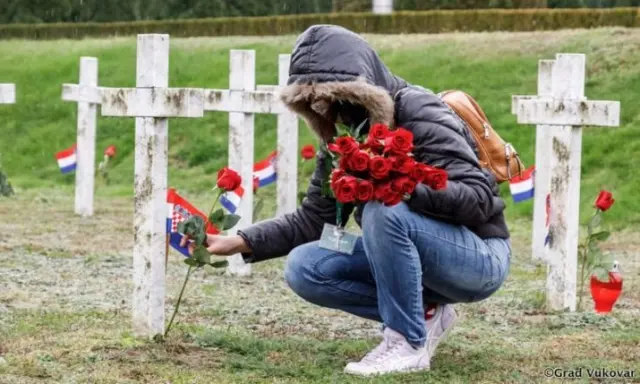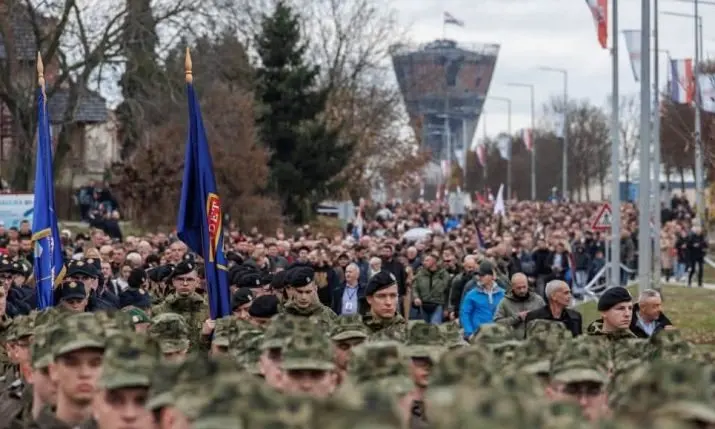
Every year on 18 November, a river of people moves quietly through Vukovar, a Danube-side town in eastern Croatia. This year the Remembrance Procession drew an estimated 100,000 participants from Croatia, Bosnia and Herzegovina and further afield, all marking the anniversary of the city's fall in 1991 during the Croatian War of Independence.
The walkway is lined with Croatian flags and banners naming participants' hometowns — Livno, Trogir, Pokupsko, Gospić. Entire families come with young children, and many first-timers make long journeys to attend. One 26-year-old who travelled from central Bosnia said he had wanted to come for years before finally making the trip, passing the restored Eltz Manor, a landmark that was heavily damaged in the war and has since been rebuilt.
The route's most solemn element is its leadership: defenders of the city and surviving staff of the wartime hospital walk at the front. Before 1991, the hospital employed more than 1,000 people; only around 250 were still there when the city fell. Eighteen of them were killed at Ovčara on 20 November, along with 182 other victims — a massacre remembered the day after the procession itself.
Vukovar's mayor, Marijan Pavliček, noted that although the town has physically recovered and now looks much like any other Croatian town, more than 300 residents are still listed as missing, which keeps the grief raw for many families.
The same day saw a parallel procession in Škabrnja, a village in northern Dalmatia near Zadar, marking the 35th anniversary of its fall to Yugoslav People's Army and Serb paramilitary forces. Thousands of participants walked through the village there too.
For travellers, this is one of Croatia's most significant national commemorations — far from the Adriatic beaches most visitors see, but deeply woven into how Croatians understand their country. Vukovar is about a three-hour drive from Zagreb and sits near the Serbian border, with the Danube running right through it. If you happen to be in Croatia in mid-November, watching or respectfully joining the procession offers an unmatched insight into the country's modern history. Outside the anniversary date, the town is worth a day trip for its baroque Eltz Manor, the Vukovar Municipal Museum inside it, the water tower scarred by shelling that now stands as a memorial, and the Ovčara memorial centre. Škabrnja is easily combined with a stay in Zadar.
If you do attend, treat it as what it is: a memorial, not a spectacle. Locals are overwhelmingly welcoming to respectful visitors, but walk, don't gawk, and leave the selfie stick in the bag.