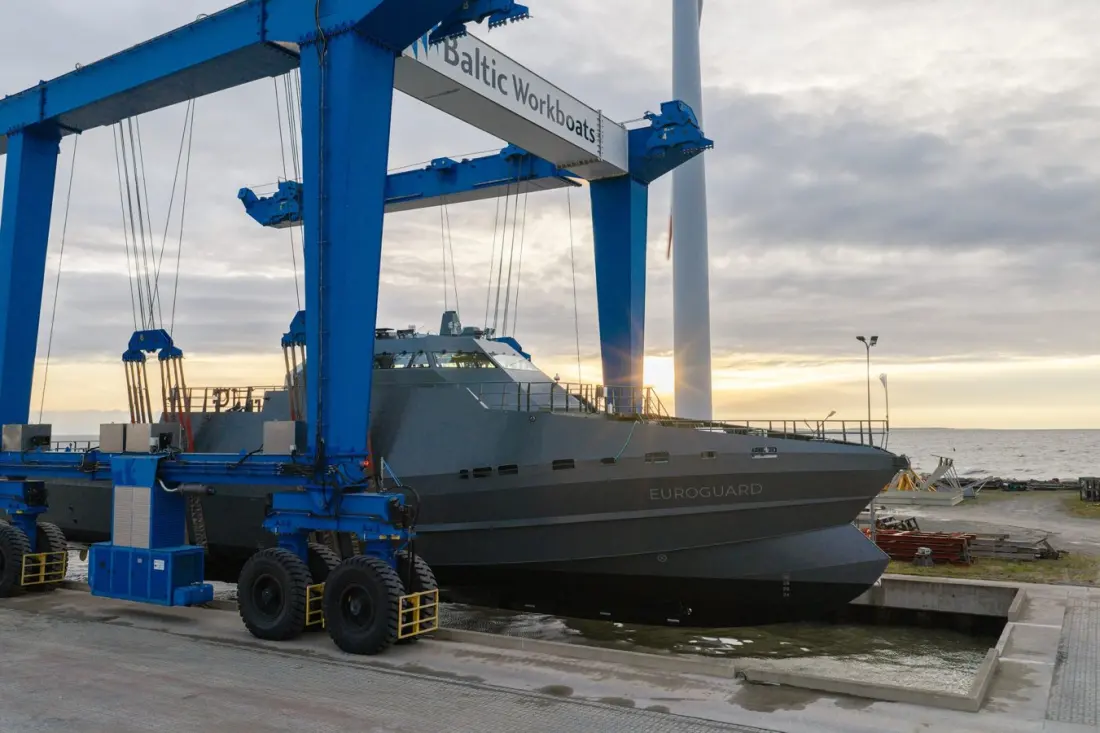
A shipyard on the Estonian island of Saaremaa has pulled off something the country hasn't managed in three decades: launching a warship built at home. On 18 November, Estonia's president christened Euroguard at Nasva, the base of Baltic Workboats — a yard better known for workboats than naval hardware. At 45 metres long, it's the largest warship built in Estonia since independence in 1991, and it was led not by one of the continent's giant defence firms but by a 200-strong Estonian company.
Euroguard is less a fighting ship than a full-scale laboratory. The €95 million project — €65 million from the European Defence Fund, the rest from the participating states and companies — brings together Naval Group, Thales, Leonardo, Navantia, Kongsberg and Damen, plus research partners from Poland, the Netherlands and Sweden. In 2027, engineers working with the Estonian Navy will take the ship into local waters to test how technologies from ten European countries actually perform together at sea.
The ship itself is deliberately versatile. It can carry up to 100 tons of equipment, swapped out depending on the mission: hunting naval mines one week, monitoring seabed cables and pipelines the next, or supporting search-and-rescue and environmental work. It draws just three metres of water — handy for shallow Baltic coasts — can stay out for ten days, cruises at 20 knots and has a range of at least 2,000 nautical miles. Trials will test both remote control from shore and fully autonomous navigation, where the ship plans routes and avoids collisions on its own.
Potentially the most valuable output isn't the hull at all. The consortium has developed GENSA, a shared technical framework that lets equipment from different manufacturers talk to each other aboard a naval vessel. If it proves itself at sea, any future European warship design could reuse it — and Baltic Workboats hopes the whole exercise positions it to build Estonia's next generation of navy ships itself.
Why does this matter to travellers? Mainly as a snapshot of where Saaremaa is heading. The island long known for windmills, spa towns and quiet Baltic beaches now hosts one of Europe's more interesting naval engineering projects, and the Nasva yard near Kuressaare is a point of local pride. If you're visiting, a stop at the harbour town gives you a new angle on an island usually sold on nature and history. Between sea trials, Saaremaa remains a laid-back summer escape — cycle the causeway from the mainland, explore Kuressaare's medieval castle, and enjoy a corner of Estonia that industrial ambition hasn't touched yet.