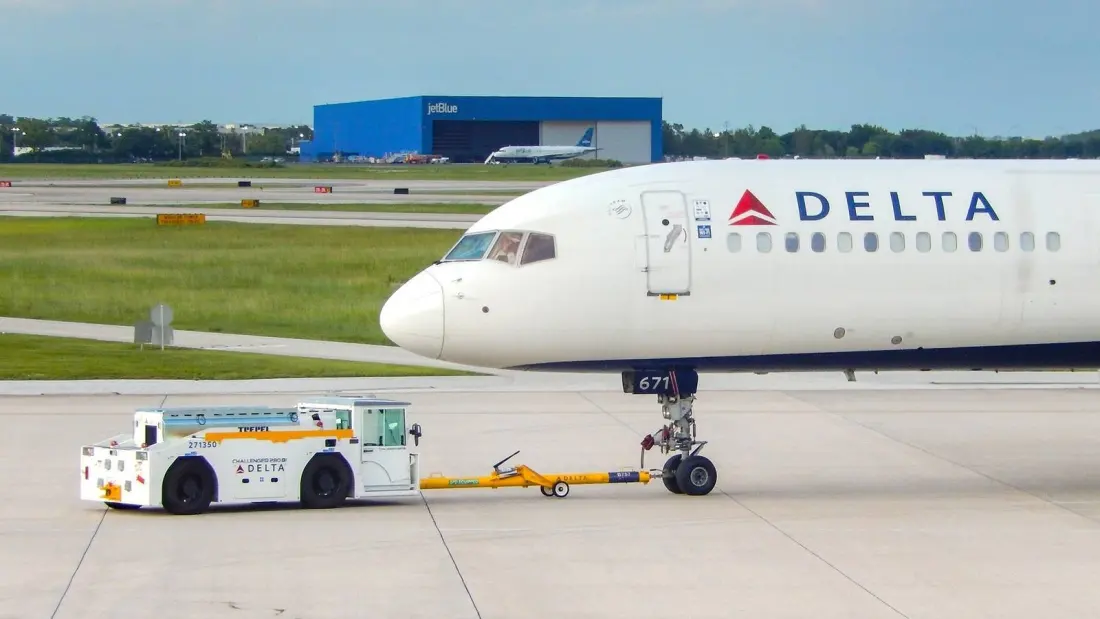
It's a scene at every airport in the world: an aircraft with engines producing tens of thousands of pounds of thrust sits idle at the gate until a small tug trundles it backwards. It looks absurd, but there's a simple reason for it. Airliner wheels aren't powered — there's no transmission linking engines to landing gear — so a plane can't just select reverse and roll out of its stand.
That said, aircraft can technically reverse using thrust reversers, which redirect engine exhaust forward. Older jets with rear-mounted engines actually did this routinely. The Boeing 727, Douglas DC-9, McDonnell Douglas MD-80, BAC 1-11, Fokker 100 and Soviet Ilyushin IL-62 all performed what's called a powerback, thanks in part to clamshell-style reversers and engines tucked at the back of the fuselage, well away from the terminal. American Airlines' huge MD-80 fleet and Northwest Airlines' DC-9s were famous for it, and carriers including Eastern, AirTran and Alaska Airlines used the technique too. It was never a free-for-all, though — specific gates had to be approved and ground crews had to confirm the area behind the aircraft was clear.
So why did powerbacks vanish? Northwest Airlines dropped them in 2005 to conserve fuel — a telling move, since it still ran a big DC-9 fleet perfectly suited to the manoeuvre. Money was only half of it. Modern airliners like the A320, Boeing 737, 777 and A350 hang their engines under the wings, close to the ground. Reversing them near a terminal blasts hot, turbulent air across the ramp, kicks up debris that can damage engines or injure ground staff, and adds wear to the reverser hardware. Pilots also can't see behind the aircraft, so ground crew would be needed anyway — which removes much of the point of skipping the tug.
The capability isn't entirely gone. The Boeing C-17 Globemaster III military transport can back up under its own power, even on a 2% slope, because its reversers redirect both fan and core thrust upward and were designed for austere airfields where no tug exists. Commercial aviation simply has different priorities: a tug gives precise, low-speed, predictable movement with none of the jet-blast risks.
For travellers, this is one of those quirks that explains the pre-departure rhythm — doors closed, headset plugged in, tug connected, pushback, engine start. If you ever spot a video of an MD-80 reversing away from a gate on its own, you're looking at a piece of aviation history that fuel prices, engine placement and plain practicality retired in the mid-2000s. The next time you're pushed back in perfect silence by a vehicle the size of a van, you'll know why the jet doesn't just do it itself.