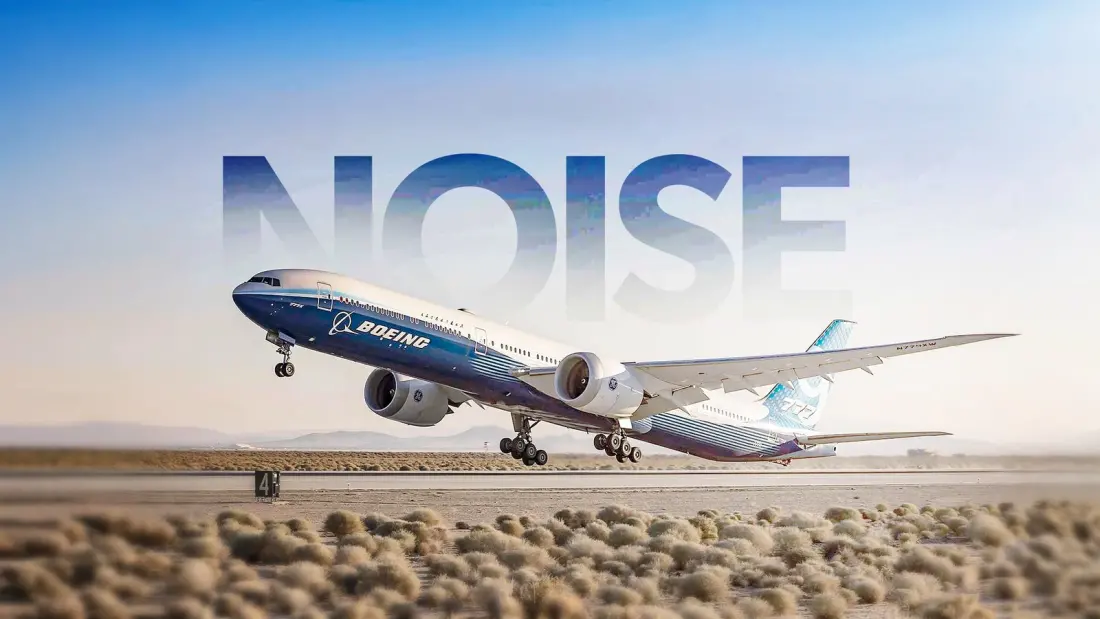
Boeing spent years putting serrated 'chevron' edges on its engine cowlings — the 787 Dreamliner, the 747-8 and even the 737 MAX all wore them. The wavy trailing edges, born from NASA research, mix hot exhaust with slower outside air to soften jet roar. So when early 777X concept images showed the giant GE9X engines with the same sawtooth treatment, it looked like a signature carried forward. Then the serrations quietly vanished.
The reason comes down to arithmetic at cruise altitude. Chevrons help most during the first few minutes after takeoff, but they can't be retracted, and over a 16-hour flight they bleed roughly 0.5% in drag and thrust. On a route like Dubai to Los Angeles, that translates to between 1,200 and 1,800 pounds of extra fuel burned every flight — millions of dollars per airframe over a multi-decade service life. Chevron roots also cracked and delaminated under exhaust temperatures around 600°C, adding maintenance headaches. Boeing's 777X chief project engineer Terry Beezhold says the final smooth-cowled design meets stricter noise rules without any of that penalty.
How? The GE9X attacks noise at its source. Jet roar comes from the shear layer where fast exhaust slams into still air, and the louder the exhaust speed, the exponentially worse the noise. Instead of pushing air out fast, the GE9X pushes an enormous column of it out slowly, using a 10:1 bypass ratio and an 11-foot (134-inch) carbon-fibre fan with just 16 blades. That makes it the largest commercial jet engine ever built and about 10% more fuel-efficient than its GE90 predecessor. Noise suppression moved inside the cowling too: Safran-built titanium nozzles lined with micro-perforated honeycomb acoustic liners leave the 777X running eight decibels below current limits — headroom in case regulations tighten.
There's an interesting twist: Airbus and Rolls-Royce reached the same conclusion a decade earlier. They studied chevrons in the early 2010s, decided a 0.5% cruise fuel penalty was unacceptable for a clean-sheet design, and never fitted them on the A330neo or A350. Rolls-Royce's three-spool Trent XWB and a seamless 'Zero-Splice' nacelle liner helped the A350 earn its reputation as one of the quietest cabins flying. For once, the two rivals agree.
Why should a traveller care? If you're booked on a 777-9 — Lufthansa, Emirates, Qatar Airways and others have them on order — you'll be sitting behind an engine that's quieter on the outside and, thanks to the weight saved (chevrons alone would have added up to 120 pounds per nacelle), cheaper to operate. That fuel saving is part of what keeps ultra-long-haul routes economically viable. For aviation nerds comparing the two flagship twins: the 777-9's GE9X makes up to 110,000 lbf of thrust with a 60:1 overall pressure ratio, while the A350-1000's Trent XWB produces up to 97,000 lbf with 22 titanium fan blades. The sawtooth cowling, it turns out, was a band-aid whose time had passed.