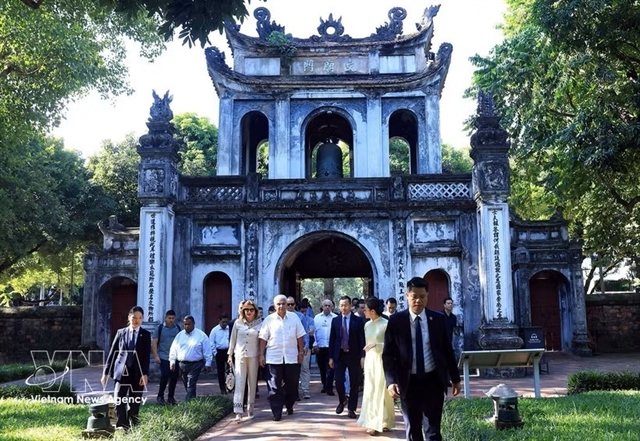
If a Panamanian president, the Prime Minister of Liechtenstein, Germany's head of state and Emmanuel Macron have all filed through the same courtyard in recent months, it's worth asking what's drawing them. The answer is Văn Miếu – Quốc Tử Giám, Hanoi's Temple of Literature, and 2026 marks a big anniversary for the place: 950 years since King Lý Nhân Tông founded Quốc Tử Giám in 1076, widely regarded as Vietnam's first university.
The numbers behind the site are genuinely striking. The Doctoral Stelae Garden holds 82 stone tablets inscribed with the names of 1,304 doctoral laureates from the Lê and Mạc dynasties — records of an examination culture stretching back centuries. UNESCO added the steles to its Memory of the World Register in 2011, and curators frame them as a window into how Vietnam historically thought about education, talent and moral responsibility. Confucian learning arrived from East Asia but was adapted here into something distinctly Vietnamese, which is part of why the site resonates with international visitors.
That resonance explains its newer role. Vietnam now regularly hosts visiting leaders here rather than in a conference hall. When President Macron toured in May 2025, he walked the full axis — Văn Miếu Gate, Đại Trung Gate, the Khuê Văn Các pavilion and Thiên Quang Well — to a soundtrack of Huế royal court music, then beat the ceremonial drum at Thái Học as a gesture of friendship. Panama's President José Raúl Mulino and Liechtenstein's Brigitte Haas followed, each signing the guestbook and praising the site's educational legacy. Even spouses' programmes get in on it: a 2026 exhibition of nearly 950 student success stories had guests painting conical hats and trying silk weaving.
For ordinary travellers, the diplomatic fuss is confirmation of what guidebooks have long said: this is one of Hanoi's most rewarding stops. The complex is green, quiet and easy to move through at your own pace — pavilions, courtyards, the well and the stele garden in one compact space right in the city. It works as a half-hour stroll or an hour-plus visit if you linger over the inscriptions and exhibitions. Go early to beat tour groups, and pair it with nearby stops around the Old Quarter.