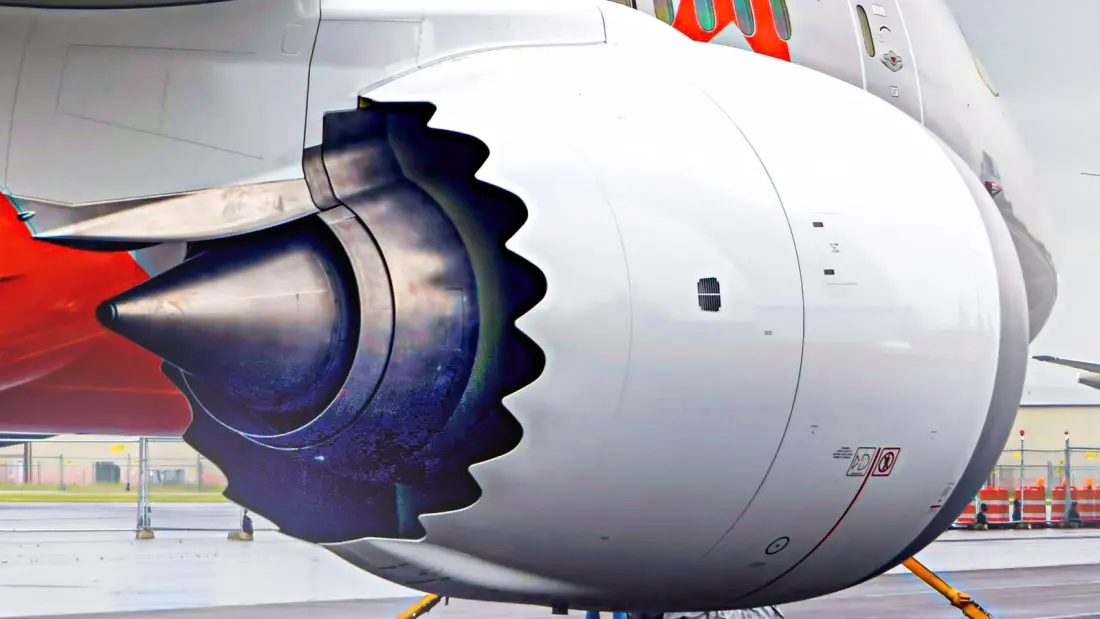
Ever noticed the jagged, sawtooth edge at the back of a Boeing 787's engine? Those zigzag tips are called chevrons, and they're one of the most recognisable design signatures on modern Boeing jets. They also appear on the 747-8 and the 737 MAX — and nowhere else. The reason other planemakers never copied them comes down to a patent, a trade-off, and eventually a change of heart at Boeing itself.
Chevrons work by smoothing the way hot exhaust air from the engine core mixes with the cooler bypass air flowing around it. That gentler blending cuts aerodynamic noise, helping jets meet tough noise rules and making cabins more pleasant for passengers. Boeing patented its nacelle-mounted version, so Airbus couldn't use the exact design — and chose not to develop its own. Instead, the A320neo, A350 and A330neo rely on sound-absorbing acoustic lining inside the engine nacelle.
Here's the catch: chevrons protrude into the airflow, creating drag and vortices that steal energy from the exhaust. The penalty is small — estimated at up to 0.5% of thrust — but in aviation every fraction of fuel burn matters to airlines watching operating costs. Airbus judged the noise reduction wasn't worth it. Interestingly, Boeing has now come to a similar conclusion: the upcoming 777X, once shown in concept renderings with chevrons, will fly without them. Its enormous GE9X engines — a 134-inch fan diameter and a 10:1 bypass ratio — are inherently quieter, and better acoustic treatments mean chevrons are no longer needed.
The wider context is striking. A Boeing 707 taking off in the 1960s could exceed 110 decibels; a 787 today typically comes in under 95. Because the decibel scale is logarithmic, that's more than four times quieter — despite the 787 being far heavier. Regulators have driven this progress: the FAA's Stage Five noise standards, effective in 2017, require a cumulative 17-decibel improvement over the old Stage Three rules.
The chevron story also illustrates a broader split in engineering philosophy. Boeing builds the 787 fuselage from composite barrels to save weight; Airbus sticks with panel construction on the A350 for easier manufacturing and maintenance. Boeing favours big windows and raked wingtips; Airbus prefers smaller windows and blended winglets that fit standard gates. Neither approach is wrong — both giants just bet on different trade-offs.
For travellers, this is more than trivia for your next plane-spotting session. Quieter engines mean less sound-deadening material in the fuselage, which saves weight and fuel — and means a less fatiguing long-haul flight for you. So if you're flying a 787 or 737 MAX, those sawtooth edges are quietly working in your favour, while on an A350 the silence comes from lining you'll never see. Either way, modern jets are roughly four times quieter at takeoff than their 1960s ancestors, and the trend is only heading one direction.
Simple Flying