El Salvador packs 242 volcanoes into one of Central America's smallest countries — 36 of them still active, 10 monitored around the clock for seismic activity. Sitting squarely on the Pacific Ring of Fire, where the Cocos Plate grinds under the Caribbean Plate, this compact nation has built an identity around its smoking peaks, fertile ash-rich farmland and crater lakes.
For travellers, that translates into an unusually dense concentration of hikeable volcanoes, most clustered in the country's central and western highlands. Santa Ana, also called Ilamatepec, is the tallest at 2,381 metres and the star attraction: a trail leads to a crater holding a turquoise-green lake, with views over Lake Coatepeque and neighbouring volcanoes from the top.
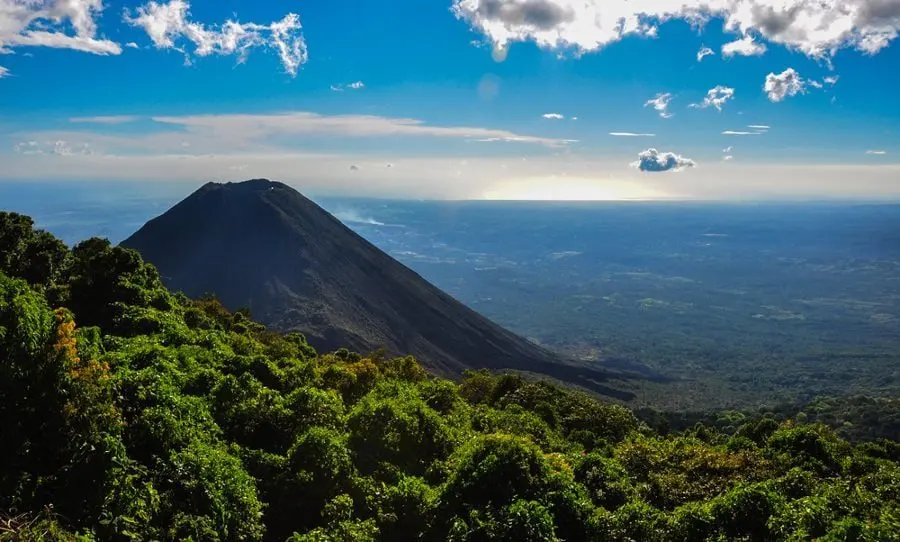
Nearby sits Izalco, the so-called Lighthouse of the Pacific, whose regular eruptions once guided ships along the coast. Its near-perfect black cone is usually tackled on guided hikes starting from Cerro Verde National Park — a cooled-off, forested old volcano with easy walking trails, gardens and lookout points over both Izalco and Santa Ana. The three together form the Los Volcanes complex, arguably the best single day out in the country.
Short on time? San Salvador Volcano sits right on the capital's doorstep. El Boquerón National Park protects an enormous crater ringed by walking trails, and the cooler mountain air and ridge-top restaurants make it an easy half-day escape.
Further afield, the options get more varied. San Miguel, or Chaparrastique, is a striking 2,130-metre cone in the east and one of the country's most active peaks — best admired and photographed from town rather than climbed casually. San Vicente's twin peaks top out at 2,173 metres, with the Amapulapa hot springs nearby as a reward. In the southeast, Conchagua rises above the Gulf of Fonseca; it's remote and harder to reach, which means quiet trails, camping spots and coastal-volcano views without the crowds.
Two more are worth the detour. Lake Ilopango, a vast caldera lake just outside the capital formed by a colossal ancient eruption, is set up for boat rides, kayaking and seafood lunches on the shore. And Tecapa, near the charming town of Alegría, cradles the Laguna de Alegría — a green-blue crater lake nicknamed the Emerald of Central America.
Guazapa offers something different again: an eroded, forested volcano where guided hikes trace former guerrilla camps and civil war history, blending outdoors and memory in a way few volcano walks do.
The variety is the point. Beginners can stick to Cerro Verde's gentle paths or El Boquerón's viewpoints, while fitter hikers can grind up Santa Ana's crater rim or Izalco's black scree. For anyone who assumed El Salvador was a transit country on a Central America loop, the volcano country alone justifies several days — with national parks, crater lakes and mountain towns strung between the peaks.