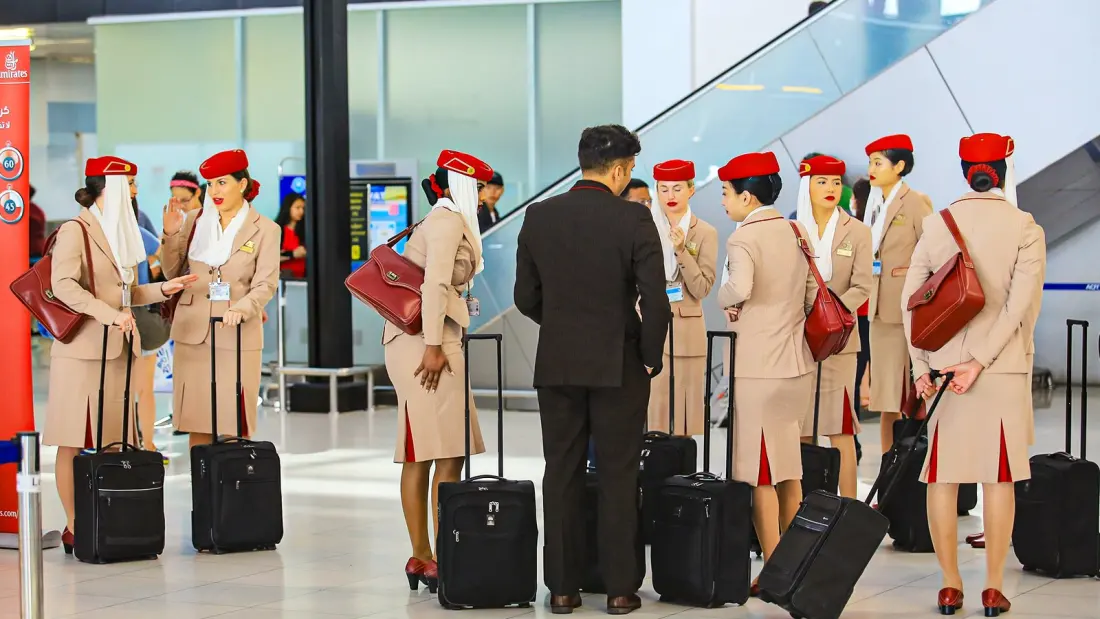
Passengers usually meet cabin crew at the aircraft door, but by then the crew has already been on duty for an hour or more, working through a checklist of safety tasks that has to be done before anyone boards.
Report times vary by airline and region. In the US, they are set by union contracts: American Airlines, for example, requires its flight attendants on duty one hour before domestic departures and 90 minutes before international flights. Contracts at other carriers follow similar patterns, with 60 minutes standard before a first departure at base and 45 minutes when starting a day away from home. Cargo and charter outfits like Air Transport International allow up to 90 minutes domestically and two hours internationally. In the UK and the Middle East, the norm is a flat 90 minutes regardless of flight length.
Once signed in, crew attend a roughly 15-minute pre-flight briefing run by the senior crew member, who assigns positions by seniority and details the flight. Everyone is then quizzed individually on safety, emergency procedures and first aid - fail that test and you are pulled off the flight. After security, crew are bussed to the aircraft to carry out a security sweep of the cabin, lavatories and galleys, check emergency equipment, and confirm meals and galley kit are loaded. Only when the senior reports to the flight deck can boarding begin.
The gate arrival is its own deadline. Legacy US carriers like American, Delta and United have crew electronically sign in 60-75 minutes out, then reach the gate 40-50 minutes before departure. Southwest recently bumped its gate time from 30 to 35 minutes on most 737-800 and MAX 8 flights, citing safety checks and longer boarding now that the airline assigns seats and deals with more carry-on bags. Turnarounds between flights run anywhere from 25 minutes at low-cost and regional airlines to 45 at legacy carriers, and 1.5 to 3 hours on long-haul, where a fresh crew often takes the aircraft home.
There is a pay angle worth knowing about, too. Historically, most US flight attendants were only paid from door closure, meaning boarding and pre-flight work went unpaid or at a reduced rate. Delta broke that pattern in June 2022 by introducing boarding pay at 50% of the hourly wage, from the start of boarding until doors close - though only for the scheduled boarding window, not delays. And the clock is unforgiving: lateness typically earns a warning, three warnings cost the job, and crew who commute to their base often travel the day before just to build in a buffer.
Why does this matter to travellers? If you have ever wondered why boarding starts 30-45 minutes before departure even on a short hop, it is because that slot sits at the end of a long chain of mandatory checks. It is also a reminder of why gate agents get firm about boarding cut-offs - the crew's schedule, and the safety checks feeding into your flight, depend on it.