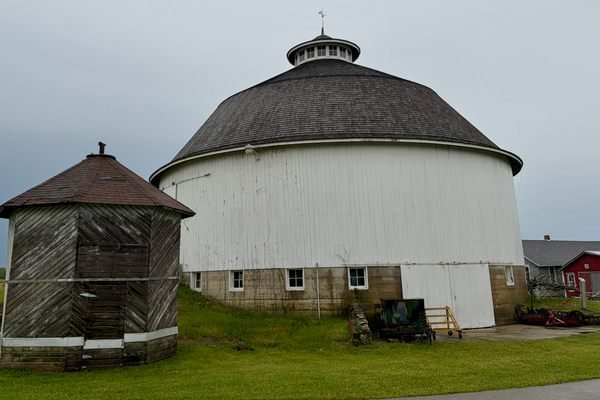
Drive through Fulton County in northern Indiana and you'll notice something odd about the farm buildings: some of them are perfectly round. The county has earned the nickname Round Barn Capital of the World thanks to a cluster of circular barns built mostly in the early 1900s, and it remains one of the best places in the United States to see this unusual piece of rural architecture.
The logic behind round barns was simple economics. A circle encloses more floor space with the same amount of siding than a rectangle, so a round barn was faster and cheaper to put up. Land-grant universities such as Purdue championed the design as the future of farming, and around 1910 a local developer named Charles Vallandingham Kindig got to work. He built the majority of Fulton County's round barns — the county once had 17 of them.
The trend didn't last. As tractors and other bulky machinery became standard on American farms, farmers needed the long, straight walls and wide doors of a traditional rectangular barn to store it all. Round barns fell out of fashion, and many were left to decay. Since 1989 the Fulton County Round Barn Museum has stepped in, relocating and restoring examples so the design doesn't disappear entirely.
For travellers, this is a low-key road-trip curiosity rather than a headline attraction — which is exactly its charm. The barns are scattered across the county, not gathered in one spot, so spotting them means cruising quiet country roads around Rochester, the county seat. The museum is the natural first stop for orientation and history before you go hunting for the survivors dotting the farmland. Photography fans will find the geometry endlessly rewarding, especially in autumn when Indiana's cornfields turn gold around them.
It's also a story about a moment when American agriculture briefly believed in a different shape. The barns are physical evidence of a land-grant-college era when efficiency was measured in board-feet of siding, and their decline mirrors the mechanisation that reshaped the Midwest. Anyone with an interest in vernacular architecture, vintage farm life, or just an offbeat detour between Chicago and Indianapolis will find an afternoon here well spent.