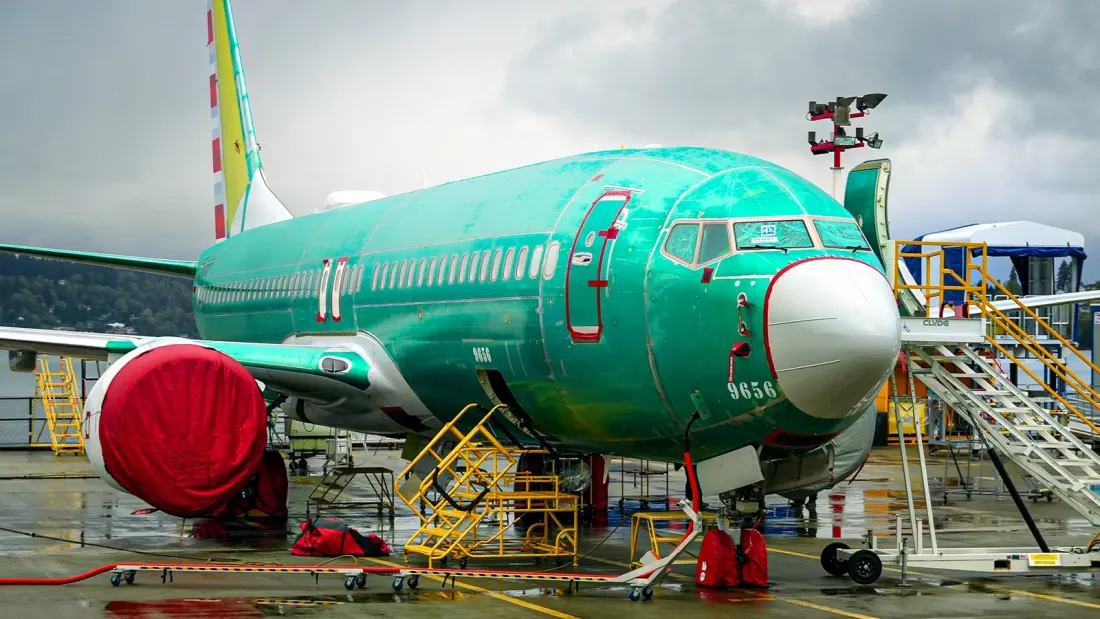
Spot a brand-new Boeing sitting outside its factory and there's a good chance it's a vivid emerald green. Fresh Airbus jets, meanwhile, tend to look like a mismatched patchwork of matte greens, yellows and tans. Neither colour is a design choice for its own sake — it all comes down to coatings, regulations, materials and even where the photos are taken.
What looks like a single green coat on a Boeing is actually two layers. There's a corrosion-inhibiting primer underneath, plus a glossy peelable protective film known in the trade as Spraylat or TPC. Because Boeing's 737 and 777X fuselages are still fundamentally aluminium designs — the 737 dates back to the 1960s — that thin metal skin needs serious protection. The peelable film especially matters because Boeing hauls 737 fuselages around 2,000 miles from Wichita, Kansas to Renton and Everett on open railcars. The BNSF-run journey crosses Nebraska, Wyoming and Montana and takes ten to 12 days, with three or four fuselages per train. A single scratch on thin aluminium can trigger an inspection, hence the armour of green paint.
Composite aircraft skip the green entirely. The carbon-fibre 787 Dreamliner can't corrode like metal, so it emerges in white or light grey under UV-protective primers, and its rival the A350 gets a tan or beige coat for the same reason. The 777X is the fun in-between case: an aluminium fuselage in glossy green film attached to composite wings finished in white or grey.
Airbus works differently. The EU's strict REACH rules are phasing out hexavalent chromium far faster than US regulations, so Airbus pushed chromate-free primers onto its fleet starting with the A380 in 2016. Without the peelable green film, the raw structural primer is what you see — flat, chalky and often pale green or yellow. And because Airbus builds components in four home countries — fuselage sections in France and Germany, wings in the UK, tails in Spain — each site applies its own primer with slightly different chemistry. The result is that famous patchwork look when the sections finally meet.
There's also a photography bias at play. Boeing jets are usually snapped early, still in protective film on railcars or the flight line, while Airbus aircraft get photographed later — off the BelugaXL, at final assembly or on acceptance flights, when they're already in pale primer. Different light in Washington versus Toulouse and camera auto white balance do the rest.
For anyone who loves planespotting or factory tours, this is a genuinely useful decoder ring: green and glossy usually means a Boeing in transit, patchy matte shades mean a European-built Airbus mid-assembly, and any white or beige fuselage is a tell for carbon-fibre construction. Plenty of travellers encounter this first-hand at places like the Museum of Flight in Seattle or Airbus tours in Toulouse, where knowing what the colours mean makes the visit far more interesting. Details via Simple Flying.