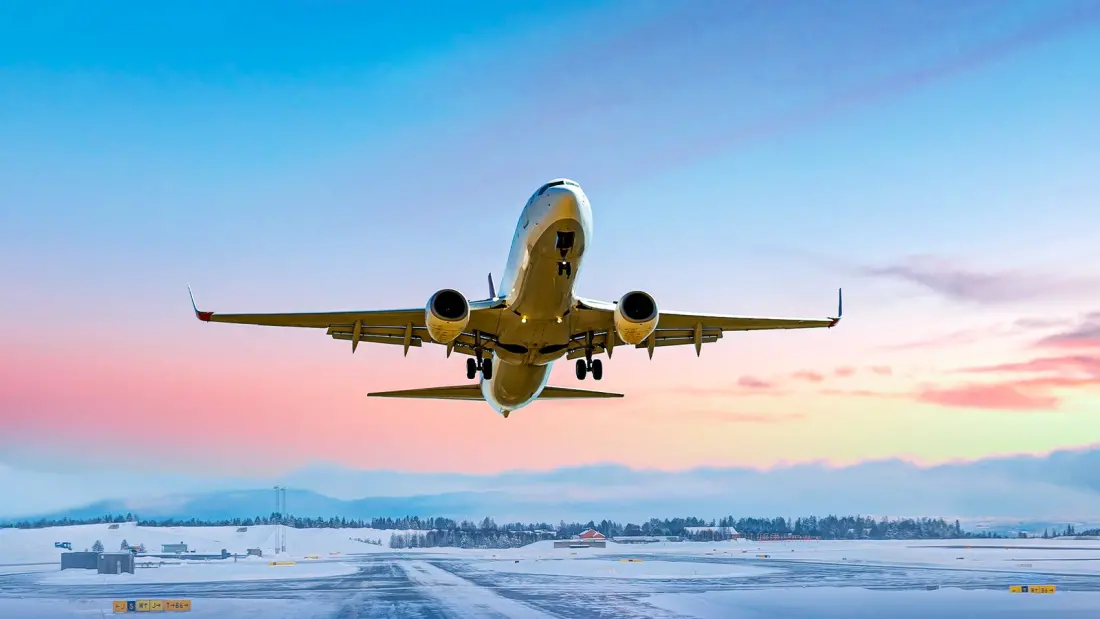
Every day, aircraft linking North America with Asia take a shortcut most passengers never think about: straight over the Arctic Circle. Earth's curvature makes those high-latitude routes the shortest way between continents, but flying them demands procedures that don't apply to an ordinary flight over, say, the mid-Atlantic.
The core problem is that everything pilots normally rely on gets shaky near the poles. Satellite navigation (GNSS — GPS plus Galileo, GLONASS and BeiDou) degrades at high latitudes, and WAAS, the US augmentation system, doesn't work there at all because its satellites sit over the equator. So crews lean on RAIM integrity monitoring, inertial reference systems, and old-school ground navaids as backups. If a GPS anomaly hits, it must be reported to air traffic control immediately, per FAA guidance.
If an aircraft has to leave its assigned route — weather, a technical fault, lost navigation — there's a rehearsed escape pattern: turn at least 30 degrees off track, fly parallel on a track five nautical miles to the side, keep altitude if possible (and add 500 feet of separation, or 1,000 feet above flight level 410), then broadcast intentions on the emergency frequency 121.5 and the air-to-air channel 123.45. Because there's no radar over the poles, this standardised move is what keeps aircraft apart until contact is restored.
Spacing gets even tighter near the pole because meridians converge, squeezing parallel tracks closer together. That's why crews use Strategic Lateral Offset Procedures, flying up to two nautical miles right of their assigned track — across 21 possible positions — to spread traffic out and cut wake turbulence risk. Offsetting left or beyond two miles right is never allowed.
Communication is the other half of the deal. Polar flights file detailed waypoint plans that feed the ADS-C automatic surveillance system; if that drops, pilots fall back to CPDLC datalink or high-frequency voice, using unambiguous coordinate formats like 52N030W. Aircraft also need certified long-range navigation capability — specific PBN and datalink codes in the flight plan — before they're cleared to fly these routes at all.
For travellers, the practical upshot is that polar flying is getting more accessible. Greenland has just extended Nuuk's runway, prompting United Airlines to launch nonstop Newark flights, while Air Greenland now connects Iqaluit in Canada — a first link between Inuit communities by air. And if you ever splurge on a Qantas Antarctica sightseeing flight, you'll be experiencing some of this rarefied aviation for yourself. It's a reminder that the remotest airspace on Earth runs on decades of international coordination, not luck.
Why it matters: whether you're on a New York–Singapore nonstop or chasing Arctic adventures, knowing that polar routes require certified aircraft, drilled contingency moves and constant position reporting should make the emptiest stretch of your flight feel a little less empty. Source: Simple Flying.