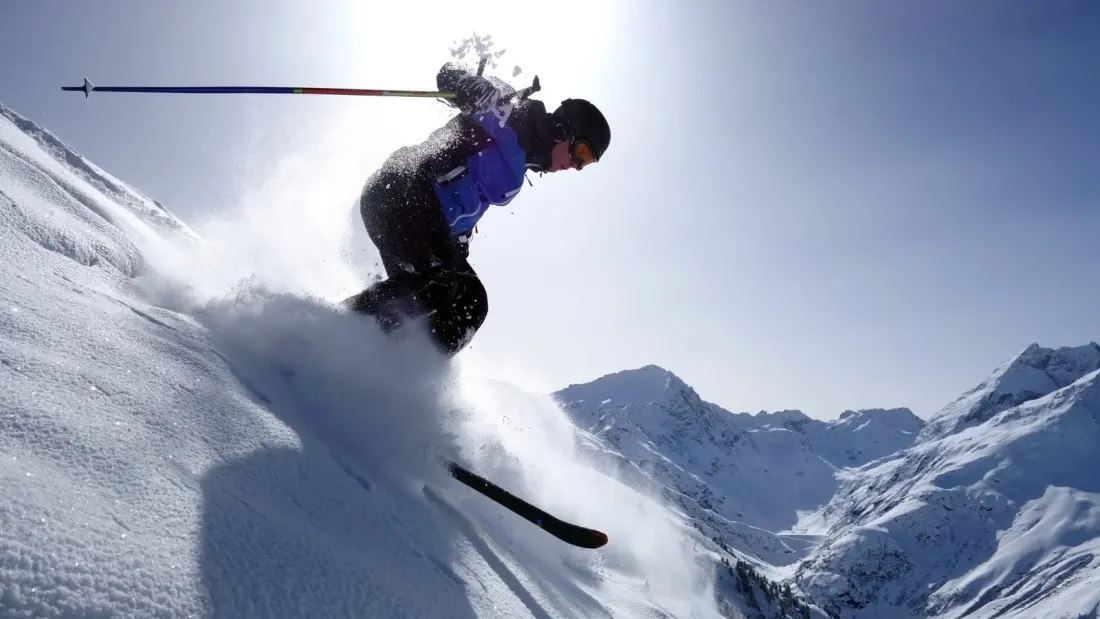
Every skier knows the pattern. Day one on the mountain feels glorious — adrenaline papers over everything. Then you wake up the next morning feeling, as one physical therapist put it, like you've been hit by a snowcat. Quads burning, calves tight, and a full ski day still ahead of you.
Milica McDowell, a Montana-based physical therapist with over 20 years of clinical experience and a family full of skiers, broke down why this happens for Outside's ski vertical. There are three main culprits. First is eccentric loading: skiing constantly forces muscles to work while lengthening — think of the lowering half of a squat — and studies show that even fit skiers lose eccentric strength in their quads and hamstrings after four hours on the slopes. That soreness peaks 24 to 72 hours later, which is exactly when day two arrives.
Second, gym fitness doesn't transfer perfectly. Regular strength and cardio work helps, but nothing quite replicates hours in a flexed ankle and flexed knee position while carving turns. Third, altitude thins the oxygen supply to your muscles, so fatigue hits sooner — and if you feel hungover without the après drinks, Cleveland Clinic says headache and fatigue from elevation can show up within a day of arriving.
The fix, McDowell says, starts four to six weeks before your trip. Her strength block has three moves: deep squat pulses (build from 20-30 seconds up to 60-75 seconds, four to six sets) to mimic repeated turns; single-leg kettlebell deadlifts (most fit people can handle 25 pounds, 12-20 reps for two to four sets); and Bulgarian split squats — a back foot elevated on a bench, weight in one hand — for eight to 12 reps across two to five sets. Add cardio intervals of 30 to 60 seconds of hard effort with three to four minutes of rest, pushing your heart rate toward roughly 75 percent of its max (about 220 minus your age). Start light, since new eccentric work causes its own soreness, and check with a doctor if you have heart, kidney, or metabolic conditions.
On the mountain itself, a five-minute warm-up makes a difference: get your heart rate 20 to 30 beats above resting with stairs or squats, then hit a wall stretch that mimics your ski boot position, a lying quad pull if you're already sore, and a lunge with a rotation toward the ceiling to wake up your spine and core.
And if day two arrives anyway? A review of 99 studies found stretching doesn't actually cure soreness — but light movement and massage do. So take a walk between ski days rather than collapsing on the couch. As 73-year-old skier Joe Puchek, who's been at it for 71 years, puts it: make the decisions today that let you ski tomorrow.
For anyone booking a ski holiday this winter, this matters more than lift ticket prices. A few weeks of targeted training is the difference between a trip where you ski every day you paid for and one where you watch the mountain from the lodge with an ice pack. Source: Outside Online.