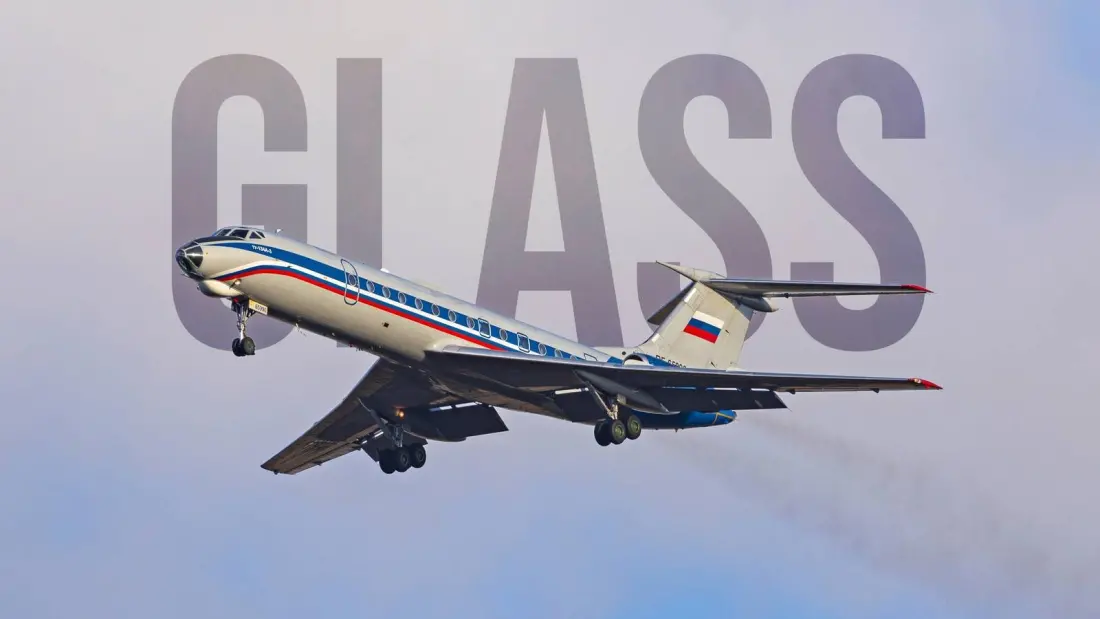
Spot a vintage Ilyushin Il-76 or an early Tupolev Tu-134 and one detail jumps out: a fully glazed nose, navigator perched behind the glass, scanning for landmarks. Western jets from the same era look nothing like it — so what happened?
Glass noses were actually the norm for everyone during the Second World War. British Lancasters and Halifaxes, American B-17s and B-29s, and German Heinkel He 111s all carried bombardiers and navigators who aimed by eye, using bombsights and visual landmarks. Even early Cold War types like the Boeing B-47 kept the glazed station. But by the 1950s the West had moved on: radar-guided bombing, terrain-following radar and later GPS meant the nose became prime real estate for radar arrays and avionics instead of a human with binoculars.
The Soviet Union took a different path, and the reasons are a mix of doctrine and necessity. Soviet electronics, miniaturised avionics and compact radar consistently lagged behind American kit — a gap that arguably persists today, given reports of Su-34 crews duct-taping commercial GPS units to their dashboards in 2022. So Soviet designers hedged, keeping a human navigator with a clear view who could eyeball a target, navigate by the stars, or check for ice below. Add in the reality of operating across Siberia and the Arctic with minimal ground infrastructure, and a pair of well-trained eyes in the nose made sense.
The result is a whole family of glass-nosed Soviet aircraft: the Tu-95 'Bear' bomber (still flying), the Tu-142, Tu-16 'Badger', the Tu-4 (an exact copy of the B-29), plus transports like the An-12, An-22, An-26 and An-30. Even airliners got in on it — early Tu-124s and Tu-134s carried a dedicated navigator in a glazed nose, partly because Aeroflot doubled as a strategic reserve airlift fleet and its aircraft were expected to pull military duty in wartime. Many Soviet transports were even designed with a secondary bombing role, a job they were mediocre at but technically capable of — Sudan has reportedly used transports as improvised bombers in its ongoing civil war.
The era is winding down. Russia's last passenger Tu-134 flight happened in 2019 (North Korea's Air Koryo kept them going a bit longer), and the state's fleet of roughly 368 An-series transports is increasingly uneconomical to maintain, with no direct replacement in sight. Within a few years, glass noses may survive only on the ageing Tu-95 fleet and the Il-76 — still built today in its upgraded MD-90A form, complete with glazing and a crew of five or six, versus the two-pilot cockpits of a C-17 or A400M.
For aviation enthusiasts, this is why catching an Il-76 or Tu-95 at an airshow or aviation museum is worth the trip: you're looking at a design philosophy — human eyes over silicon — that has all but vanished from the skies. Full credit to Simple Flying for the original report.