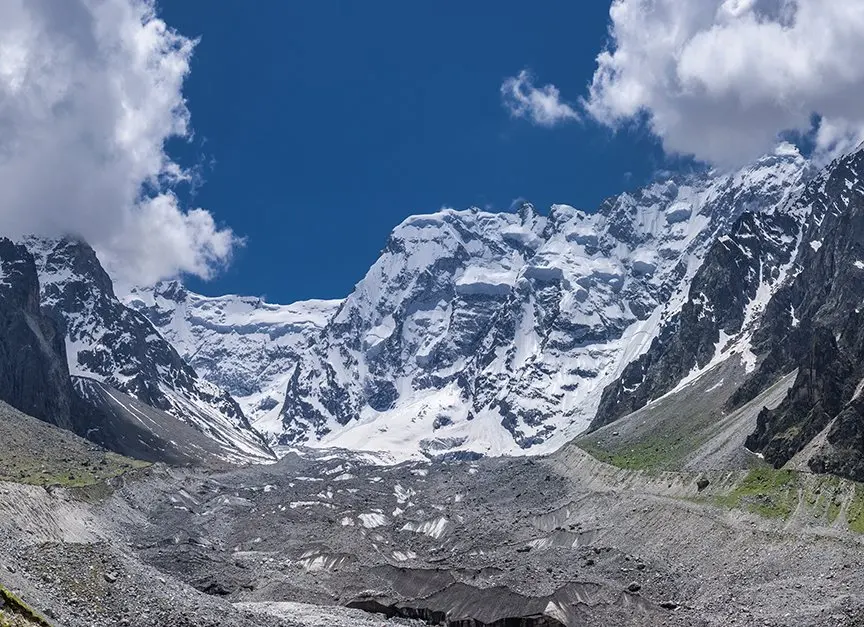
A massive avalanche on Mount Mizhirgi in Russia's northern Caucasus has killed 17 people, and officials say warming temperatures are to blame.
The disaster struck on September 6, when roughly half a million cubic metres of ice and snow broke away from a hanging glacier on the 5,047m peak and hit a military group undergoing mountain training. Ten more people were injured. A further ten escaped unharmed and made their own way down. The force of the impact was extraordinary: the blast of displaced air reportedly threw some victims 200 to 300 metres down the slope before burying them. Helicopter pilot Alexander Davydov filmed the avalanche as it happened.
Eldar Khashkhozhev of Russia's Ministry of Emergency Situations laid out the chain of events. Rising temperatures have pushed the altitude of permanent snow cover higher, leaving parts of the glacier exposed without their protective blanket. That weakened the supporting ice that had held enormous hanging masses in place for decades. Eventually gravity won, and the collapse swept into the training group below.
Was it foreseeable? Officials who inspected the region's snow conditions by helicopter just a month earlier found nothing alarming, and some insist the catastrophe could not have been predicted. But climber Dmitry Polyakov, who was in the area at the time, pushed back on that. He says mountaineers had long regarded the glacier as unstable and routinely avoided gathering near it in large groups.
It is the deadliest climbing accident in Russia since 2002, when a glacier collapse in North Ossetia killed 125 people, including local residents.
For anyone heading into high mountains, the takeaway is sobering. Familiar routes and previously safe zones can no longer be treated as reliable. Hanging glaciers that held firm for decades are losing the snow cover that protected them, and collapses can happen with little warning. Large groups clustered beneath icefall zones are a particular risk, and climbers, guides and training groups alike may need to rethink where they stop, camp and travel.