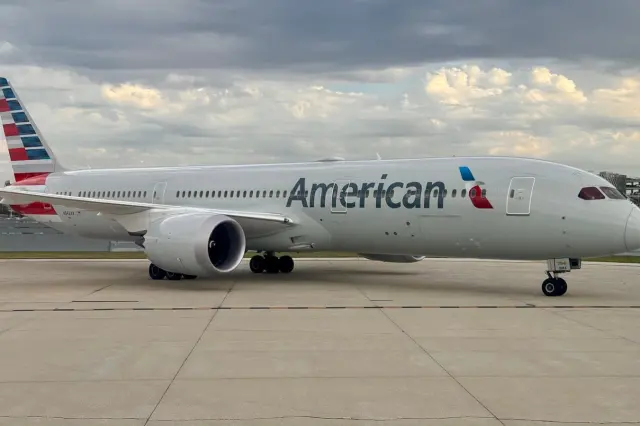
If you've sat near the back of a US regional flight recently and wondered why it was so loud, the Embraer E175 is a good place to start. The aircraft is certified and perfectly legal, but by modern standards it's noisy — and the reasons go back to design choices made in the late 1990s.
The E175 first flew commercially with Air Canada in 2005 and has since become the workhorse of American regional aviation, holding roughly 80% of the US regional jet segment. More than 800 have been built, and it's the only member of the original E-Jet family still in production. It carries 76 passengers in a two-class layout, with a range of 2,200 nautical miles — ideal for feeding passengers from smaller cities into major hubs.
So why the racket? Two factors stand out. First, the E175's GE CF34-8E engines have a bypass ratio of just 5:1, modest by today's standards. Higher-bypass engines push more air around the core rather than through it, relying less on the high-velocity exhaust that generates most jet noise. Second, the airframe simply predates modern noise-reduction thinking.
The comparison with newer aircraft is stark. Airbus says the A220 — originally the Bombardier CSeries, which entered service in 2016 with Pratt & Whitney geared turbofan engines — has a noise footprint up to 50% smaller than previous-generation aircraft, running 18 effective perceived noise decibels better than 2006 ICAO standards. The E175's engines manage a 12:1 bypass ratio equivalent in the A220's PW1500G, whose 73-inch fan and clever gearbox let the fan spin slower and quieter. Embraer's own E2 series, using the same PW1900G engine family, is rated among the quietest commercial aircraft flying today, and the upcoming E175-E2 with its PW1700G should comfortably out-quiet the original.
There's also a cabin angle worth knowing. Measured from inside, the E175 averages around 67 decibels — louder than widebodies like the A380 (56 dB), A350, or 787, partly because you're sitting much closer to the engines. Where you sit matters too: rear seats, especially near rear-mounted engines like the CRJ900's, are always noisier, and takeoff is the loudest phase of any flight.
For travellers, the takeaway is practical. If you're booking a short regional hop in the US, there's a good chance it'll be on an E175, and a decent pair of noise-cancelling earbuds is worth packing. Choosing seats forward of the wing will make the flight noticeably more pleasant. And over the next few years, as the E2 and A220 fleets grow, those loud takeoffs should gradually become a thing of the past.
The E175 isn't going anywhere soon — it remains a brilliant aircraft for the routes it serves — but its engines are a product of their era. Newer regional jets prove that quiet and efficient no longer have to be a trade-off.
Story via Simple Flying.