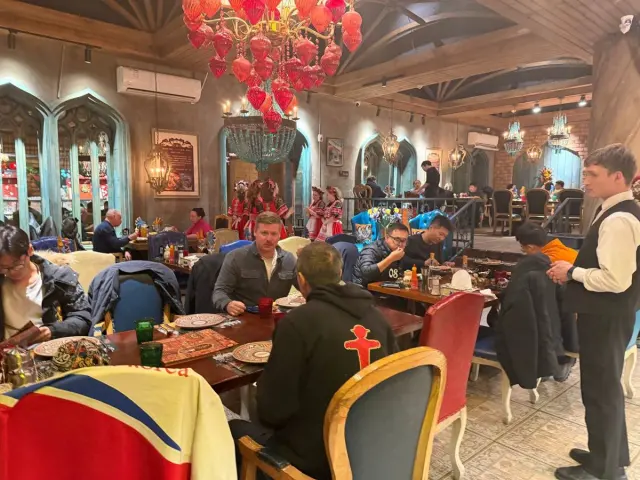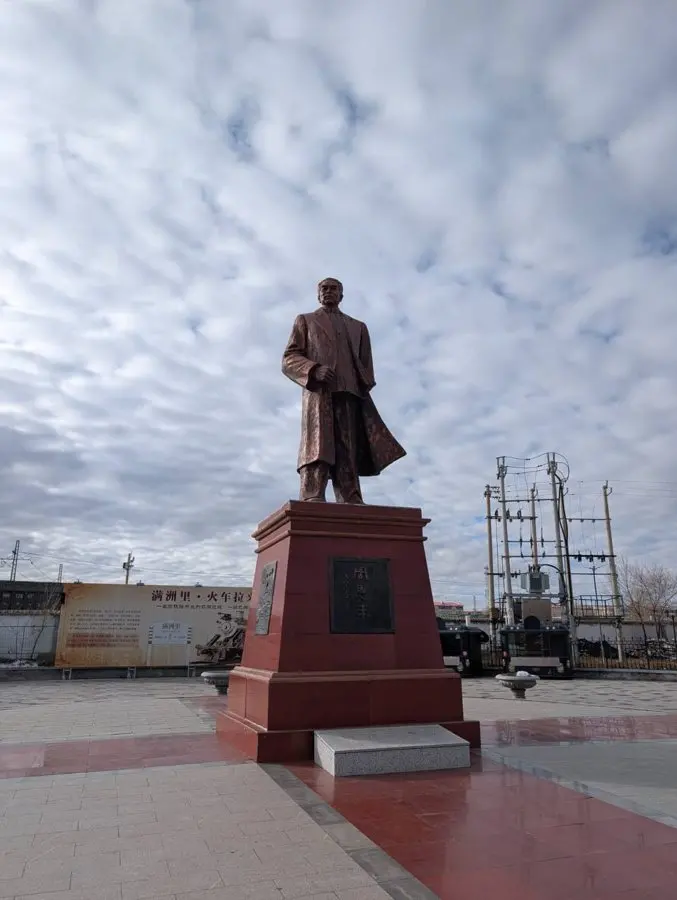
Manzhouli, the oddball Chinese city wedged between Russia and Mongolia in Inner Mongolia, has never done things by the book. Russian restaurants, a surreal "Babushka Park", and instead of the usual Chairman Mao monument, a memorial statue to Zhou Enlai — unveiled as recently as 2008.
Zhou Enlai (1898-1976) was the People's Republic's first Premier, holding the job from 1949 until his death. Born in Huai'an, Jiangsu Province, he studied in Japan and France, joined the Communist Party in 1921, and rose alongside Mao Zedong. As Premier he ran China's diplomacy and administration, helped broker the 1954 Geneva Conference agreements, and played a central part in the 1972 US-China rapprochement that brought Nixon to Beijing. Seen as a pragmatic moderating force during the Great Leap Forward and the Cultural Revolution, he remained hugely popular, and his death from bladder cancer in January 1976 triggered an outpouring of public grief that unsettled the Gang of Four and helped hasten their downfall. He's still one of the most admired figures in CCP history.
So why Manzhouli? During the Korean War (1950-1953), the city was a key railway crossing on the China-Soviet border, with Soviet military supplies and ammunition heading south through it to North Korea. Zhou approved the construction of a railway pedestrian overpass to help protect those ammunition trains from sabotage. That's the official reason the statue honours him here — unveiled in late 2008, which has led some to suspect it was as much about red tourism and city branding as historical commemoration. The Korean War, after all, no longer enjoys the prominence in China it once did.
Visiting is straightforward. The statue sits on a quiet private street, is nicely crafted, and carries plaques explaining the story. What's arguably more interesting is what surrounds it: the actual Railway Pedestrian Overpass that Zhou is credited with, and Manzhouli Junction itself. The junction handles the freight passing between Russia and China — trade currently running at record levels — and the writer behind the source describes it as the biggest gathering of trains they had ever seen.
For travellers, the statue is a fitting stop in a city that's essentially a living Soviet-Chinese mash-up. You'd pair it with a wander around Manzhouli's other curiosities: matryoshka-themed architecture, the Russian-inflected food scene, and the border atmosphere you simply won't find elsewhere in China. It's a niche stop, sure — but if you're crossing between Russia and China overland, or chasing the country's stranger corners, it's a genuinely unusual piece of Cold War-era history with a modern twist.