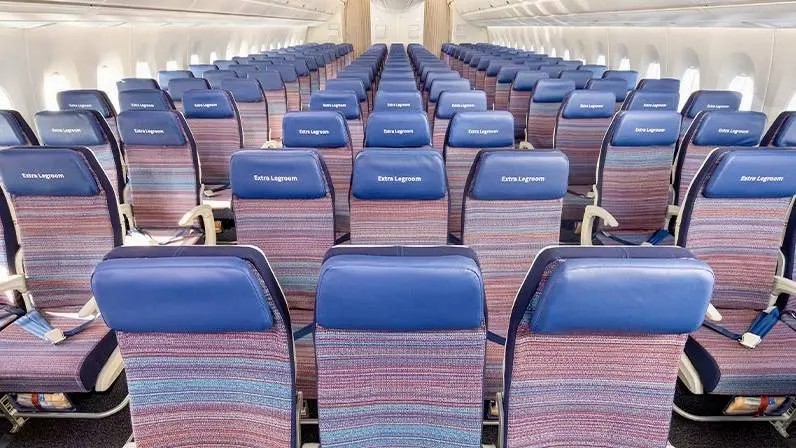
Economy class is where most travellers spend their money, and Korean Air wants to make it less of an afterthought. In a conversation with Simple Flying, the airline's chief marketing officer Kenneth Chang laid out a philosophy built on one idea: get the seat right first, then everything else follows. "If you're comfortable, then your mind starts going in different angles, saying 'what else do I want?'" he said.
That shows up most clearly in cabin density. While rivals squeeze 3-4-3 seating into Boeing 777s and A350s, Korean Air refuses, arguing that layout is simply too cramped. The airline also takes seat design seriously to an almost obsessive degree — after complaints about its Boeing 787-10 seats, it discovered that a five-degree recline worked well, but six degrees made things harder for shorter passengers, particularly anyone under 5'5". The lesson: specs on paper don't guarantee comfort.
Entertainment is another differentiator. Korean Air is rolling out 13-inch or larger 4K monitors in economy across incoming aircraft, including the 787-10 fleet, paired with what Chang describes as strict curation of content so the library actually matches what people want to watch. A sharp screen only matters if there's something good on it.
Food gets similar attention. Chang holds weekly meetings with catering chief David Pacey and customer relations staff to work through passenger feedback dish by dish. His claim: an economy meal on Korean Air should feel "fully served," not like a scaled-down version of the real thing.
Two practical changes stand out for anyone flying long-haul with the airline. First, rerouted flights around Russian airspace have added roughly two hours to services from Seoul Incheon to London Heathrow and Paris CDG, so Korean Air has introduced heartier snacks between meal services — plus self-service snack bars on some flights, so you can grab refreshments without waiting for a cart. Second, free Starlink Wi-Fi is being installed across the A350 and 777 fleets and some single-aisle jets from September 2026, with full-fleet coverage targeted for the second half of 2027. Uptake figures suggest passengers want it: about 50% connect on short-haul flights, rising to roughly 90% on long-haul.
The small stuff gets attention too — bathrooms are cleaned every 15 minutes, and crew are trained to walk the cabin regularly.
For travellers, the takeaway is that Korean Air is positioning itself as the carrier where economy passengers aren't just tolerated. If you're booking a 10-plus-hour flight to Asia and seat pitch, screen quality and reliable free internet matter to you, it's worth comparing Korean Air's economy product against rivals charging similar fares. The catch: with 150 aircraft currently and 231 on order, including 62 Boeing 737 MAX 10s and 40 777-9s, your experience will depend partly on which airframe you draw — Starlink requires per-fleet-type certification, so not every plane has it yet.
Story reported by Simple Flying.