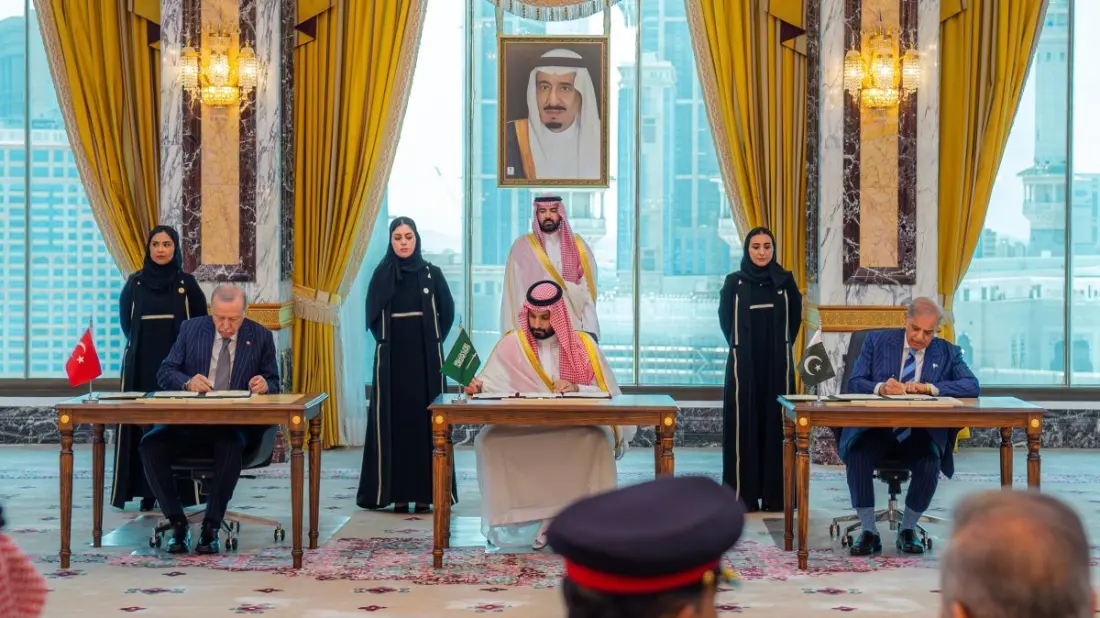
A column in Daily Sabah by professor Murat Yeşiltaş has waded into a debate that's usually confined to foreign-policy journals: is Türkiye trying to build its own order in the Middle East, or is it simply one partner among several regional states working out their shared security? The piece is a rebuttal of Meliha Benli Altunışık's Foreign Affairs article "The Fantasy of a Turkish Middle East," and it offers a useful window into how the region is changing — including for travellers trying to gauge what's opening up.
Yeşiltaş's argument draws on recent first-hand meetings in Syria and Iraq, where he says the mood was less anxiety about Turkish dominance and more appetite for cooperation: security coordination, restructured trade, connectivity projects and regular institutional contact. He frames Ankara's approach as a "neighborhood order" — the recognition that lasting security requires stronger institutions and economic ties in neighbouring countries rather than unilateral management.
Two processes sit at the centre of the story: the PKK's disarmament and the integration of the PKK-linked SDF into Syrian state structures. From Ankara's view, preventing a permanent armed authority on its southern border is core security policy, and pairing that with support for Syria's institutional integrity is presented as a shared challenge, not an imposed agenda. Iraq gets similar treatment: the Development Corridor is described as more than a transport route — its success depends on Iraqi institutions, route security and long-term Turkish-Iraqi investment cooperation.
The spikier part of the debate concerns the Mecca agreement, a defence arrangement that critics say could drag Türkiye into other countries' wars. Yeşiltaş counters that defence pacts exist chiefly to deter and de-escalate, and situates the deal against a backdrop of Iranian proxy networks and Israeli military interventions reshaping regional calculations. He also points to the Badr Agreement reached in Qatar, covering defence-industrial cooperation and training, as a separate but linked effort by regional states to rely less on outside guarantees — a pointed rebuttal of the idea that only Washington or Beijing can anchor Middle East security.
Why should a traveller care? Because the practical map of the region is quietly being redrawn. If Syria's institutions consolidate and Iraq's corridor project advances, overland routes and cross-border travel between Türkiye, Syria and Iraq become progressively more feasible than they've been in decades. Stable security arrangements in the Gulf also underpin the region's tourism and aviation boom. None of this is guaranteed — the column itself stresses the outcome is uncertain — but the direction of travel, so to speak, is toward regional states managing their own affairs. For anyone planning trips beyond the usual Istanbul-and-Cappadocia circuit, that's the context worth following.