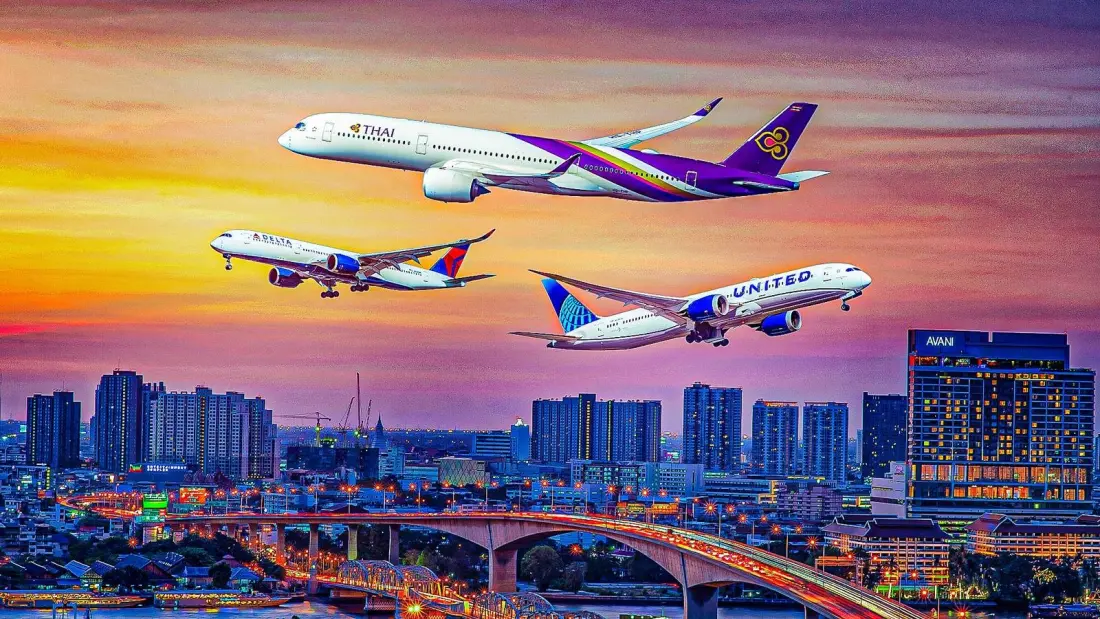
Thailand pulled in more than 35 million international visitors in 2024, yet not a single one arrived direct from the United States on a US carrier. The reasons are part politics, part economics — and for American travellers, the workaround options are actually pretty good.
The politics bit is mostly solved. The FAA downgraded Thailand to a Category 2 safety rating in 2015 after an audit found gaps against international aviation standards, which blocked Thai carriers from flying to the US. That was finally reversed in April 2025, and United wasted no time: it launched a daily Los Angeles–Hong Kong–Bangkok service in October 2025 using a Boeing 787-9. But that's still one stop, not nonstop.
The economics are the harder problem. Bangkok is roughly 8,269 miles from Los Angeles — firmly ultra-long-haul territory, where fuel and staffing costs soar and the aircraft sits far from home for long stretches. Routes like that only usually stack up when there's a steady stream of business travellers paying for premium seats. Thailand's traffic is mostly leisure and visiting friends and relatives: price-sensitive passengers who'll happily trade a few hours for a cheaper one-stop fare. Singapore's nonstop to New York works because of corporate demand; Bangkok doesn't have that cushion. Thai Airways learned this the hard way — it flew nonstop to both New York and Los Angeles with Airbus A340-500s, reportedly lost money on every flight, and had dropped both routes by 2015.
There is one nonstop option from North America: Air Canada flies Boeing 787-9s from Vancouver to Bangkok, three times weekly in summer and daily in peak winter season. It launched in December 2022 and has stuck around — partly because Vancouver–Bangkok is nearly 1,000 miles shorter than the LA routing, and partly because there's less competition in that market.
For now, American travellers are spoiled for one-stop choices. United routes via Hong Kong; ANA, Japan Airlines, Korean Air and Asiana connect through Tokyo and Seoul; Philippine Airlines competes hard on price via Manila. For a more premium experience, Cathay Pacific, Singapore Airlines and EVA Air all funnel through their hubs, while Emirates, Qatar Airways and Etihad serve Bangkok via the Gulf.
If a true nonstop ever happens, United is the likeliest candidate — it's in the same Star Alliance as Thai Airways, so it could feed passengers onward across Southeast Asia, and its West Coast hubs fit the route. Los Angeles has the largest Thai community in the US; San Francisco hosts most of United's transpacific flying. Growing American appetite for luxury Thailand — helped along by The White Lotus — might eventually make the numbers work. Until then, book the one-stop and plan a smooth arrival.