
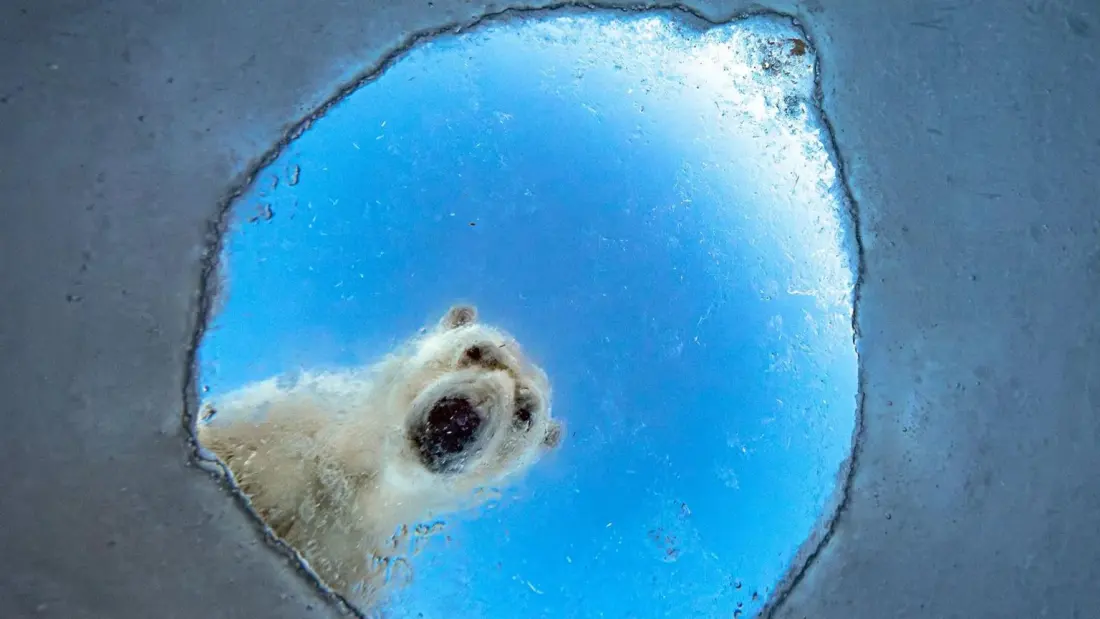
The Natural History Museum's Wildlife Photographer of the Year competition has dropped a preview of its 2026 entries, and the shortlist already reads like a greatest-hits reel of the natural world — from Arctic ambushes to a black bear doing laps in a Los Angeles swimming pool. Category and overall winners will be announced on October 13, with the museum's in-person exhibition opening three days later on October 16.
The standout image so far was captured with a motion-sensor camera rigged beneath a hole in the Arctic sea ice. It shows the view from a seal's perspective — the very last thing it saw, seconds before a polar bear struck. Another Arctic entry, from Vegard Byrkjeland Aasen of the Norwegian Orca Survey, is harder to shake: an adult orca carrying the body of a dead calf, documenting what researchers believe is mourning behaviour in these whales.
Human and animal worlds collide in several entries. Jack Crockford, a teenager competing in the 15-to-17 category, caught a swift in flight beside a jet — two flying machines with near-identical outlines sharing the same frame. In California, meanwhile, a cinnamon-coloured black bear was photographed taking a dip in a suburban pool. With housing spreading into their habitat, black bears have become regulars in backyards, despite their starring place on the state flag.
Then come the hunts that didn't go to plan. Jens Cullmann photographed an African bullfrog lunging at a babul butterfly, proof that predator-and-prey drama runs all the way down the food chain. Allegra Hutton's entry shows a young leopard clinging awkwardly to a tree trunk, squirrel clearly out of reach.
A few images earn their spot on pure visual punch. Bence Mate shot a flock of red-billed queleas swirling above a glowing waterhole, and Shane Gross — the 2024 overall winner — contributed a split-level frame: a storm raging above the surface while a school of bigeye trevally cruises below, entirely unbothered.
For travellers, this is more than eye candy. The exhibition at the Natural History Museum in South Kensington has become one of London's most reliable autumn fixtures, and it's a genuinely good rainy-day plan whether or not you care about cameras. If you're in the city between mid-October and the new year, it slots neatly alongside the museum's free permanent galleries — and the neighbouring V&A and Science Museum make the whole block an easy full-day stop. Photographers planning their own wildlife trips can also mine the shortlist for inspiration: orcas in Norway, polar bears in the Arctic, queleas at African waterholes. The images double as a rough field guide to where the world's best animal encounters happen, and when.