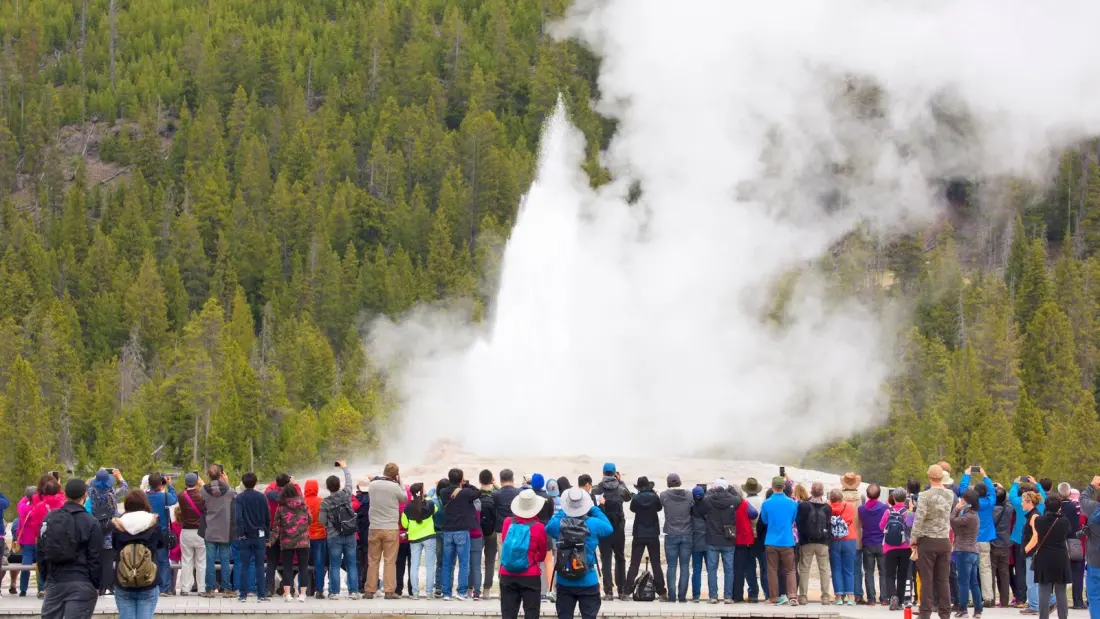
A fist fight broke out near the Old Faithful parking lot on a summer afternoon in Yellowstone National Park. Drivers cut each other off in a snarled, semi-apocalyptic car park; families double-parked and honked; and a recent geyser clean-out turned up fidget spinners, fake nails and a cap that read "cowboy hat." Writing in an op-ed for Outside Online, one author argues the park has slid back into the chaos of its earliest years — and the comparison is more than a rant.
The numbers back the mood. Yellowstone now draws roughly 4.5 million visitors a year, up from about 3 million two decades ago. Meanwhile the National Park Service workforce has been cut by nearly 25 percent since 2025, and some interpretive signage has been replaced. Bad behaviour is visible everywhere: visitors stepping off boardwalks onto fragile thermal crust, smartphone-wielding "wildlife paparazzi," and the occasional fatal plunge into acidic hot springs.
Here's the twist: none of this is new. When Ulysses S. Grant signed the park into existence in 1872, funding never followed. In the first decade barely a thousand visitors a year made the trip — and still, vandals chiselled away at mineral deposits, poachers left fields of bison and elk carcasses, squatters built illegal cabins, and tourists hurled soap into geysers to force artificial eruptions. After the railroad arrived in 1883, the problems scaled up: pickpockets, horse thieves, and stagecoach robbers staged what are said to be the largest stagecoach robberies in U.S. history — three times over. The park became known as a fun place to get away with things, precisely because rules existed but nobody enforced them.
The fix, when it finally came, was telling. In 1880 the park's entire enforcement budget covered one game warden, Harry Yount, expected to patrol more than 3,300 square miles alone. He quit after 14 months, arguing the job needed a properly funded ranger service. The government tried vigilante cowboys (who preyed on wealthy tourists instead of outlaws), then the U.S. Army, and only in 1916 — 35 years after Yount's warning — created the National Park Service. Order followed.
The lesson for today is obvious: crowding plus budget and staffing cuts equals misbehaviour. But visitors aren't helpless. The author's own day improved dramatically once he left the lots behind — a six-mile walk through the quieter reaches of the Upper Geyser Basin, watching Daisy Geyser erupt for a dozen people, then feeling the ground thump underfoot at Black Sand Pool. An Oregon family he met there had cracked the code too: stay at several park lodges and hike outward in the early mornings, before the day-trippers swarm. The rule-breakers, he notes, remain a loud minority — most of the 4.5 million follow the rules and respect the rangers.
If you're planning a trip, the takeaway is simple: go early, go deep, and don't let the parking lot colour your whole impression of the world's most active hydrothermal zone. And if you want to appreciate what a properly funded ranger service saved, duck into the old log Army post at Norris Geyser Basin — now the Museum of the National Park Ranger — where a weary bronze bust of Harry Yount still keeps watch.