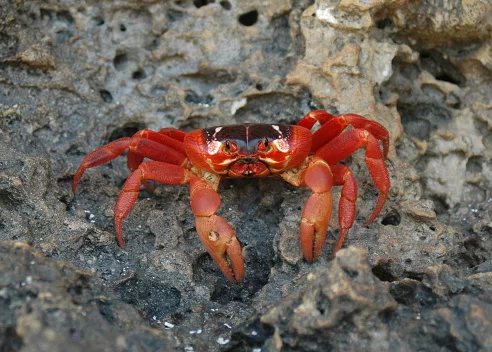
Each year, as soon as the rainy season arrives, Christmas Island effectively changes hands. More than 100 million red crabs leave the rainforest and march towards the ocean to spawn, swarming forest floors, roads and specially built bridges on an island that measures just 135 square kilometres. It's often called one of the greatest wildlife shows on Earth, and it's happening now.
The timing is astonishingly precise. Parks Australia explains that the migration is governed by lunar cycles: the crabs aim to release their eggs before dawn, on a receding high tide, during the moon's last quarter. That means the exact dates shift each year, but the window generally falls between October and December, once the first proper rains soften the ground. For travellers, this unpredictability is part of the appeal — and the challenge.
Getting there is no small feat either. Christmas Island is a remote Australian territory in the Indian Ocean, roughly 350km south of Indonesia and over 1,000km from the Australian mainland, so reaching it requires commitment. Those who make the trip are rewarded with scenes unlike anywhere else: roads closed for crab crossings, rangers herding crustaceans with leaf rakes, and beaches turned crimson at dawn.
The scale of this year's migration is also a conservation success story. Invasive yellow crazy ants once devastated the crab population, displacing tens of millions by overtaking their burrows. Ongoing control programmes have helped numbers climb from an estimated 50 million to more than 100 million. That matters beyond the crabs themselves — they're a keystone species, and their burrowing and feeding keep the island's rainforest ecosystem healthy.
For wildlife travellers, the practicalities are worth knowing. The migration peak lasts only a couple of weeks, and the spawning event itself happens on a single morning, so flexible flights and a stay of at least a week hugely improve your odds. Visitor centres and Parks Australia publish predictions as the season approaches. Expect boardwalk viewing areas, road closures, and the instruction to drive slowly — every crab counts on an island where they outnumber people by roughly 20,000 to one. Bring a rain jacket: the crabs love the wet, and you'll likely get some too.
If you miss the mass migration, the island still delivers — whale sharks, red-footed boobies, excellent diving and some of the clearest water in the region make it far more than a one-event destination. But if you can time it right, standing on a road as millions of crabs flow around your feet is a travel memory few places can match.