A Seattle physician says he reached his United gate nearly three minutes before the airline's own cutoff, watched the screen say "Boarding Now" — and still lost his seat to a standby passenger who was already on the jet bridge. What followed was a nine-hour delay, a $1,083.80 payout, and an airline response that blamed him for missing the flight he says he made.
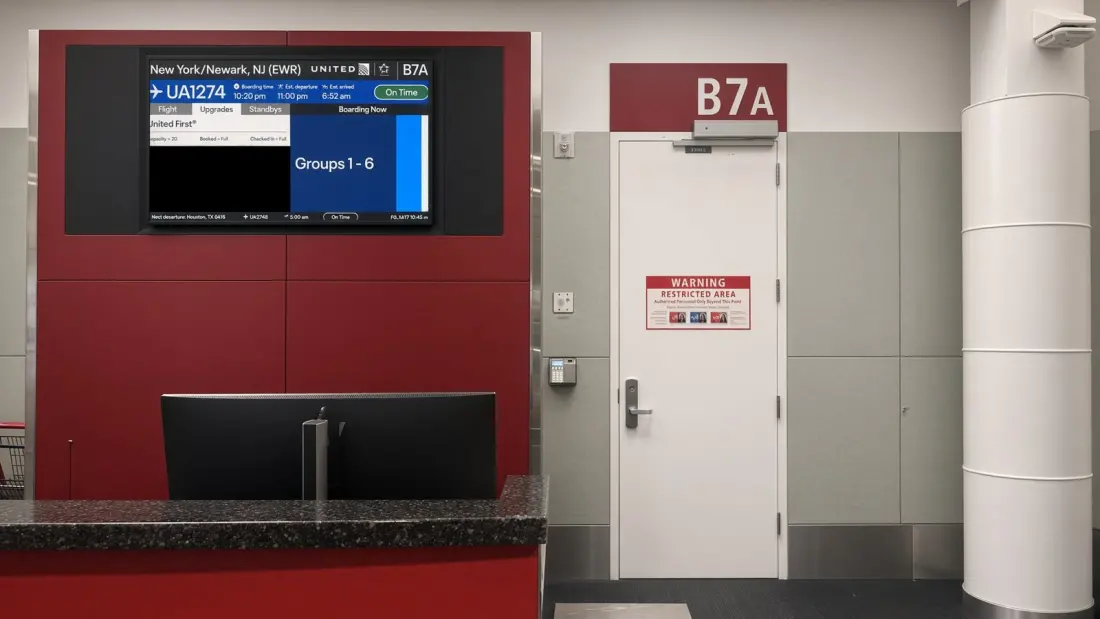
Dr. Adedeji Adeniyi was booked on United flight 1274 from Seattle to Newark on July 17, an 11 p.m. departure with a published gate deadline of 15 minutes before takeoff. He says he arrived at gate B7A between 10:42 and 10:43 p.m. — and he has the receipts. A photo he took that night shows the gate screen still displaying "Boarding Now," groups 1 through 6, with a clock reading 10:43 p.m. According to his account, the last passenger boarded at 10:47, four minutes after he showed up.
Instead of flying, Adeniyi was rebooked for the following morning, landing in Newark at 4:07 p.m. instead of his original 7:18 a.m. arrival. United initially issued a check for $1,083.80 — the statutory compensation for involuntary denied boarding — and, he says, approved another $1,083 on top. But the paperwork stung: a verification letter attributed the missed flight to "operational disruptions beyond their control," and the airline's response to his Department of Transportation complaint claimed he'd failed to board on time. He says recorded conversations and a supervisor's acknowledgement support his version of events.
The likely mechanics, as the source report reconstructs them: an agent released the seat too early, cleared a standby passenger into it, and ended up with two people expecting one seat. Once the other passenger had been accepted for boarding, unwinding the error got messy — federal rules generally protect that traveller too, and being on the jet bridge rather than in your seat doesn't make you fair game for removal. That principle was cemented after United's infamous 2017 incident in which Dr. David Dao was dragged off a flight and injured. United could instead have sought a volunteer to give up a seat, as it famously did with four-figure credit offers post-Dao, though that may have delayed the departure and agents may have feared the fallout of admitting the mistake in the moment.
Why should travellers care? Because the single most transferable lesson here is documentation. Adeniyi photographed the gate screen with its clock before boarding closed, and captured employees acknowledging he'd arrived on time. Getting hold of airport CCTV after the fact is notoriously difficult; a timestamped photo is not. If you're cutting it close at the gate, snap the board. And if an airline bumps you involuntarily, know that cash compensation exists — and that a denial letter blaming "operational disruptions" doesn't have to be the last word. A DOT complaint is a real lever.
There's a nicer footnote, too: Adeniyi went on to assist during medical emergencies on two later flights, earning a thank-you card from the crew on his rebooked Seattle–Newark leg.
Story via View from the Wing.