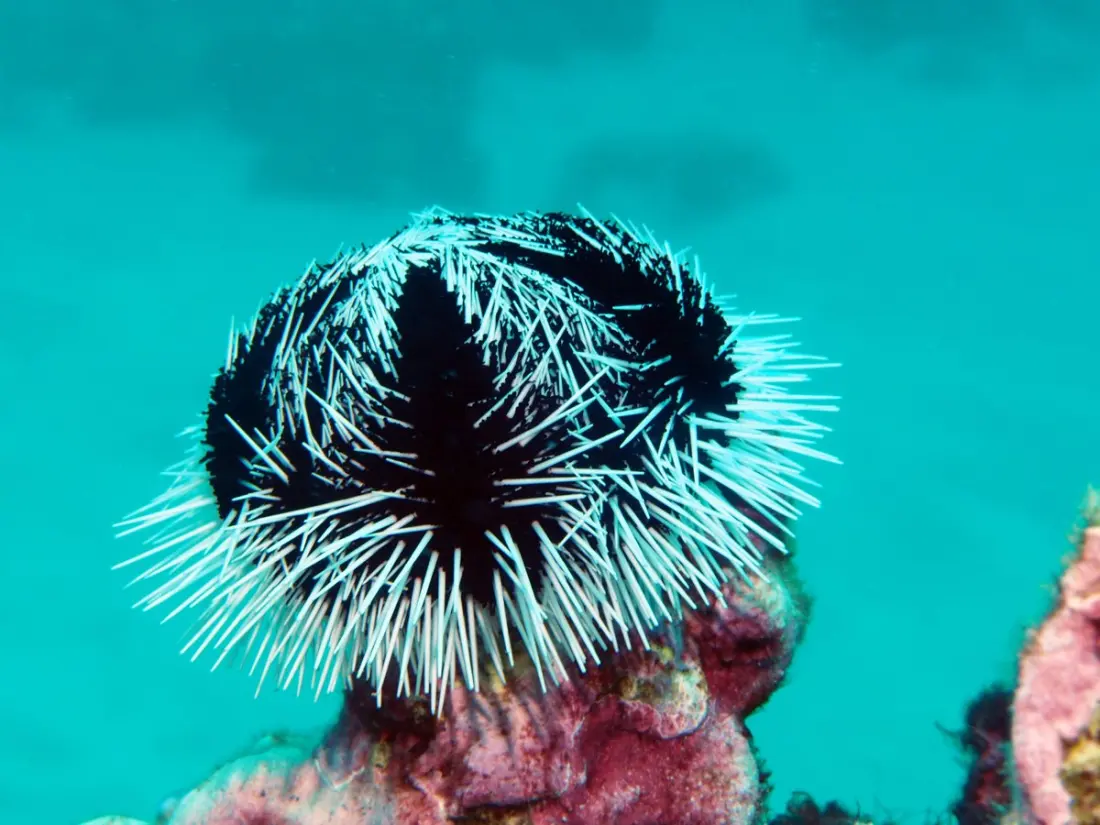
Divers on the NSW south coast are watching kelp forests vanish at a pace they've never seen before. The culprit: the lamington sea urchin, a short-spined native species nicknamed the 'demon urchin' by the Shellharbour diving community, which is moving south in large numbers and eating everything in its path.
Bill Kuiper, who has been diving at Bass Point near Shellharbour for 54 years, saw feeding fronts of the unfamiliar urchins demolish a rock platform at a popular dive site called The Gutter. Three weekends away were enough for 300-400 square metres of kelp to be stripped to bare rock. The species, Tripneustes australiae, gets its common name from the lamington cake, thanks to its white spines coated in bits of seaweed and shell.
The species is native to south-east Australia and north-west New Zealand, so this isn't a classic invasive-species story. The University of Sydney's Professor Maria Byrne, who has studied urchins for 40 years, first recorded it in Sydney Harbour in 1988, and it was long misidentified as a tropical relative. A 2023 study corrected its taxonomy — which, she notes, changes the management narrative entirely: this is a native species now behaving like an invader, likely pushed south by the strengthening East Australian Current.
Its range shift was confirmed in 2024, with large numbers recorded from the Solitary Islands down to Narooma, including Port Stephens and Sydney Harbour. Lord Howe Island's UNESCO-listed marine park has also seen outbreaks, in 2008 and again from 2024. New research led by Dr Jeremy Day of the University of Newcastle used citizen-science divers to survey 350km of coastline from Sydney to Narooma, and the findings are concerning for anyone who cares about these reefs. Unlike the familiar long-spined urchin, which grazes only to about 15m and hides in crevices by day, the lamington urchin feeds around the clock down to 40m, climbs into the kelp canopy, and has toxic spines that put off most predators. That challenges the assumption that kelp forests can simply retreat to cooler, deeper water.
There's an unexpected silver lining for food lovers. Commercial diver Kate Rogers in Batemans Bay used to harvest the odd lamington urchin as a novelty; by 2026 they were abundant enough to carry her small fishery through a weak long-spined urchin season. She can take up to 400kg a day, selling creamy uni direct to the Sydney Fish Market, where it's become a sought-after gourmet item.
For travellers, the Great Southern Reef — the kelp-and-seagrass system spanning Australia's southern coastline — is a world-class dive destination precisely because of the weedy seadragons, nudibranchs and other creatures that depend on kelp. Sites like Bass Point, Batemans Bay and Montague Island are on the front line, and divers there now may witness this ecological shift in progress. Scientists say the species' future range, and whether it can be managed through fishing, is an open question.
Reporting: Australian Geographic