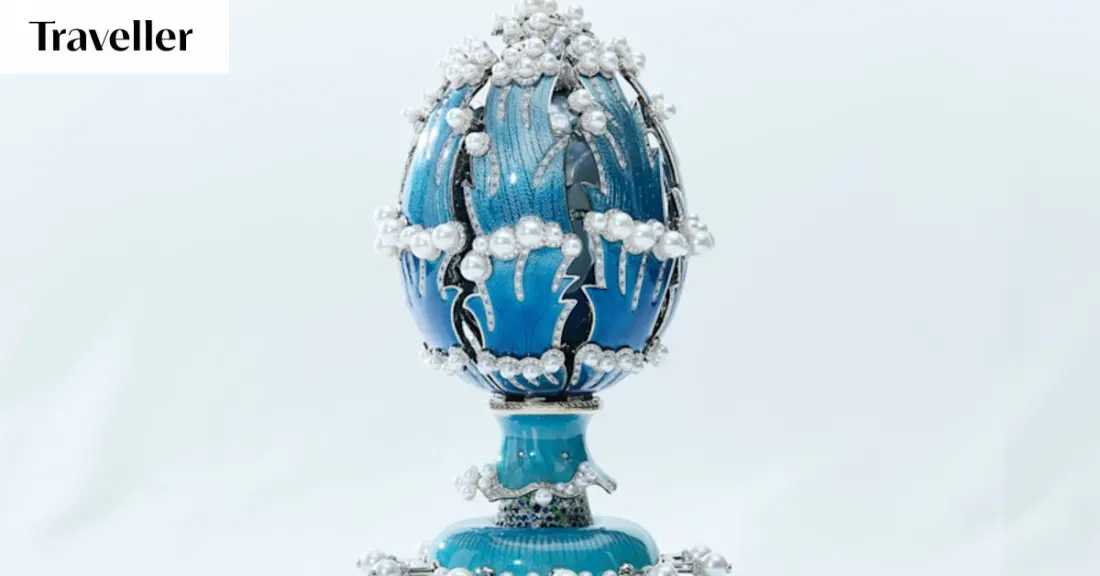
There's a Fabergé egg that never leaves the ocean. Called Journey in Jewels, it sits in the reception area of Regent Seven Seas Grandeur, and it's the only Fabergé egg in the world to live permanently at sea. The reason is fitting: the ship's godmother is Sarah Fabergé, great-granddaughter of Peter Carl Fabergé himself, and the writer caught up with the vessel on a voyage themed around the jewellery house.
This is a contemporary piece, not one of the fabled Imperial eggs, but the pedigree shows. It wears graduated blue guilloché enamel set with pearls, emeralds, tsavorites, sapphires and opals — the palette of the sea rather than the Romanov court. Turn the pearl-set "helm" at its base and seven enamelled blades swing open to reveal a second, smaller egg hidden inside. Given that comparable treasures fetch millions, the writer's onboard magician buddy went pale when asked whether he could pocket it for a disappearing act.
The deeper story from the voyage: eggs were only ever a fraction of Fabergé's output. At its peak the House of Fabergé employed roughly 500 craftsmen and produced an estimated 150,000 to 200,000 objects — clocks, fans, perfume bottles, cigarette cases, jewellery and carved stone animals. Its rarest pieces, collectors say, may actually be the flower studies. To make them, Fabergé kept a greenhouse on the roof of his St Petersburg headquarters so his artisans could study exotic blooms before recreating them in stone.
For travellers, the best news is where much of this ended up: the United States. With Russia on Australia's "do not travel" list, America holds the most accessible Fabergé collections anywhere. The Houston Museum of Natural Science houses the McFerrin Collection, more than 600 objects built up over decades. The Virginia Museum of Fine Arts in Richmond displays the Lillian Thomas Pratt collection, including several Imperial Easter eggs alongside intricately worked cigarette cases — single objects combining engraving, chasing, stone-setting and enamelling. Washington DC's Hillwood Estate explains why so much Fabergé reached America at all: after the Russian Revolution, the Soviets sold off Imperial treasures for hard currency, and Marjorie Merriweather Post — reportedly the wealthiest woman in America in her day — bought many of them, leaving her house and collection to the public. New York's Metropolitan Museum places it all in the broader sweep of European decorative arts.
Want to see the egg in person? Regent's Spotlight Voyages programme has an eight-night Spotlight on Wine sailing from Rome to Venice aboard Seven Seas Grandeur, departing 11 July 2027, from $10,230 a person. Pair a cruise with a museum crawl through Texas, Virginia and DC and you can trace the full Fabergé story without setting foot in Russia.
Story via Traveller (Sydney Morning Herald).