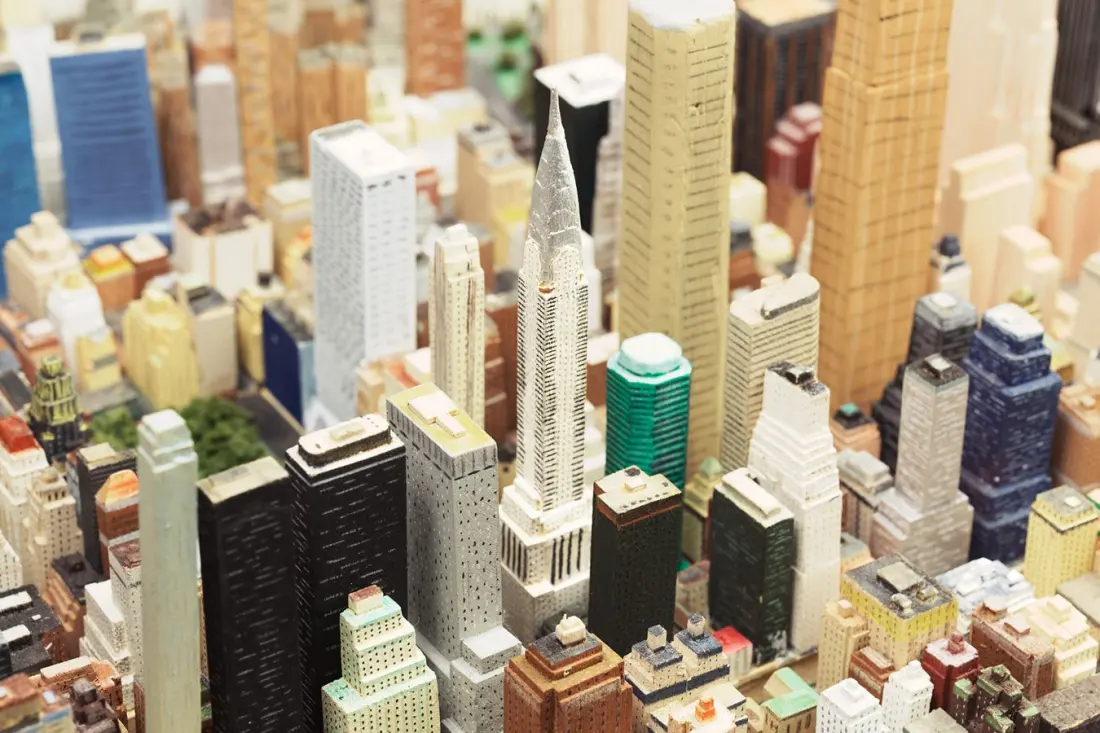
Joe Macken drove buses and trucks for a living. In his spare time, over more than two decades, he built a model of New York City containing more than 800,000 structures — and it's now on display in the city it depicts.
The exhibition, He Built This City: Joe Macken's Model, opened at the Museum of the City of New York in February 2026 and runs until 12 October 2026. The model spans roughly 15 by 8 metres, assembled from more than 340 sections, and covers all five boroughs plus chunks of New Jersey and Long Island. Famous landmarks are all in there — the Statue of Liberty, Yankee Stadium, the Brooklyn Bridge — and the museum hands out binoculars so visitors can squint at buildings deep in the middle of the grid.
What makes the model interesting is that it isn't a snapshot of today's city. Macken mixed eras. A Queens diner from his childhood sits where a newer building now stands. The old Kosciuszko Bridge remains, though the real one was replaced in 2017. And in Lower Manhattan, the Twin Towers stand next to One World Trade Center. As Macken put it, he kept a lot of his own parts of the city.
The seed was planted on a school trip to the Queens Museum, where he saw its famous Panorama of the City of New York. He didn't start his own version until his 40s, after moving from Long Island to the Albany area, beginning with 30 Rockefeller Plaza. Midtown alone took about ten years, with the Empire State Building's tower proving the toughest detail to nail. He had no formal training, working in balsa wood and cardboard, and even packed supplies on family holidays and built during breaks from weekend bus-driving shifts.
The model stayed a private obsession until his daughter pushed him to post videos on TikTok. They racked up more than 10 million views in a week, the museum got in touch, and the rest is exhibition history. Macken isn't done either — he plans to add more than 50 buildings and push the model further into New Jersey and Long Island.
Why should a traveller care? Because visitors aren't just hunting landmarks. People use the model to walk their own memories — one visitor, Jonathan Skolnik, traced his father's first American address and the Queens neighbourhood where he was born. If you're in New York before October 2026, it's a genuinely unusual way to see the whole city at once, memory and skyline folded together.
Story via Travel Tomorrow.