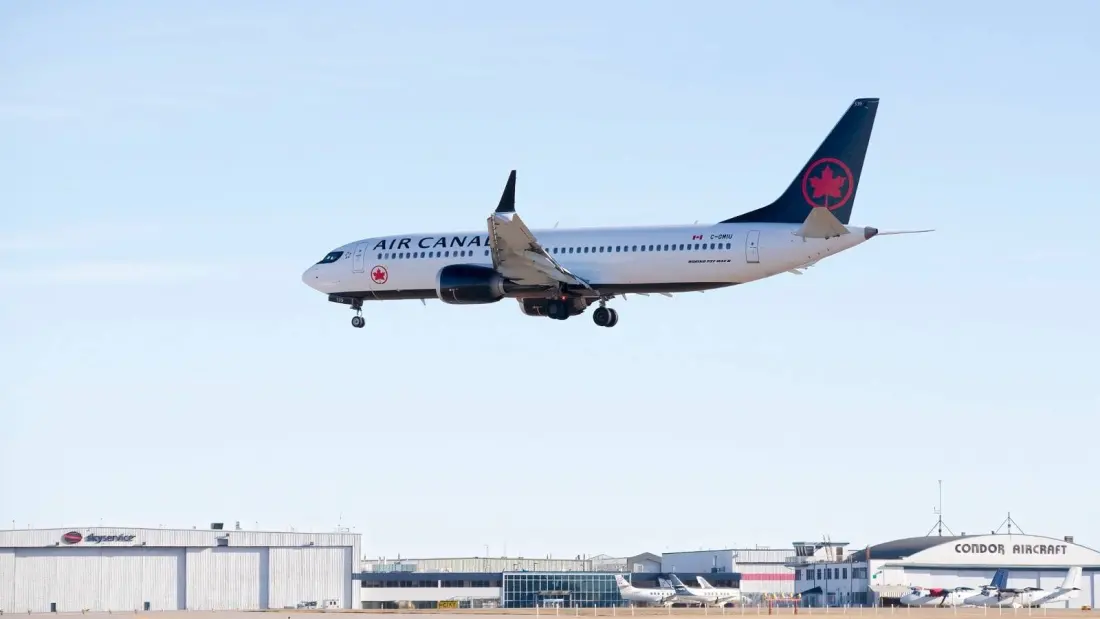
A routine afternoon flight from Palm Springs to Vancouver turned eventful minutes after takeoff, when the crew of Air Canada flight AC1769 got an automated warning that another aircraft was too close for comfort.
The flight, a Boeing 737 MAX 8 registered C-FSDB, left Palm Springs International Airport at 12:45 local time on November 17, headed for Vancouver. While climbing through roughly 11,400 feet, its Traffic Collision Avoidance System flagged a small Cessna that was reportedly not responding. The system issued what's known as a resolution advisory — an instruction for the pilots to change altitude immediately — and told them to climb. They went up 600 feet to 12,000 feet to put extra vertical space between the two aircraft.
This wasn't a near-miss warning light blinking in the background. A resolution advisory is the more serious of the two alerts TCAS can issue, and it's generated by the aircraft itself, reading transponder signals from nearby traffic rather than waiting for air traffic control. Regulators expect pilots to follow these instructions straight away unless doing so would put the aircraft at risk. The Air Canada crew did exactly that, and the flight carried on as normal.
There was no diversion, no return to Palm Springs and no reported emergency. The jet landed at Vancouver International at 16:45 local time after a flight of about two hours and 40 minutes, and flight-tracking data confirms the aircraft completed its scheduled route. No findings from US or Canadian authorities have been published about what actually happened.
A few questions remain open. The Cessna's registration hasn't been disclosed, and it's unclear whether the smaller aircraft failed to answer a radio call or ignored a controller's instruction. Nobody has confirmed how close the two planes actually came — the source reports only that the alert happened, not the minimum separation. Palm Springs sits under some of the busiest mixed general aviation and airline airspace in the US, so encounters between small private aircraft and commercial jets climbing out of the airport are the kind of thing TCAS was designed to catch.
For travellers, the takeaway is reassuring rather than alarming. The system did its job quietly: an automated instruction, a prompt climb, and passengers landed in Vancouver on schedule a few hours later, most of them unaware anything had happened. It's a good example of the layers of safety that sit behind even an ordinary holiday flight — and of why a moment of climbing bumpiness mid-ascent usually means the crew is following procedure, not improvising.
Details first reported by aviation outlets AIRLIVE and AeroSillage, per Simple Flying.