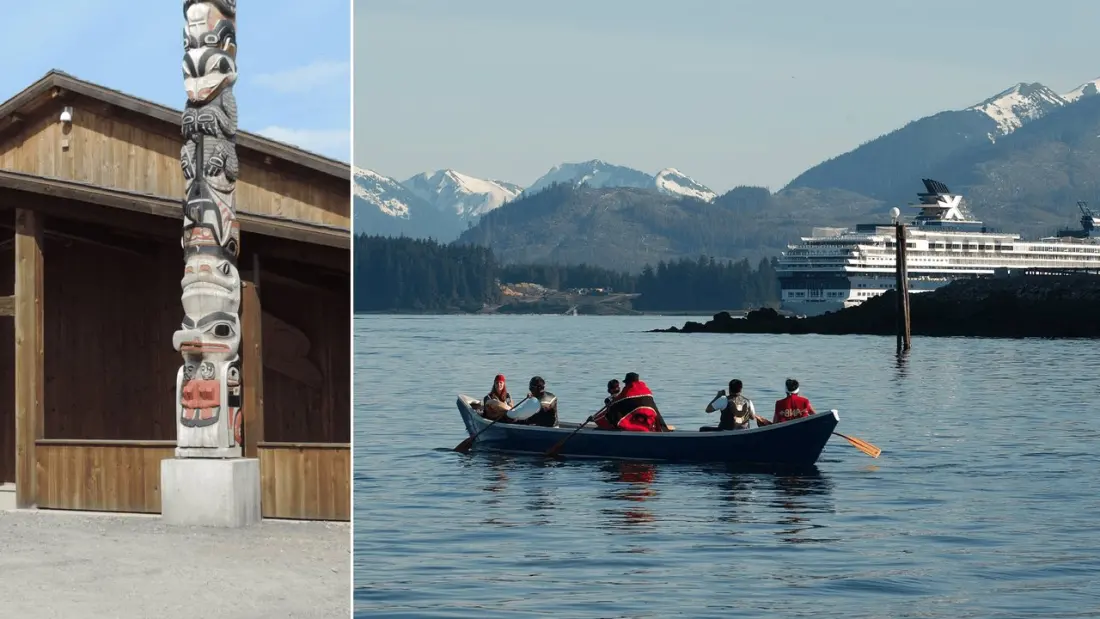
Cruise passengers pouring off ships in Juneau this season may notice something new along the downtown waterfront: carved cedar totem poles. They're part of Kootéeyaa Deiyí, the Totem Pole Trail launched in 2023 by the Sealaska Heritage Institute, which installs poles representing Tlingit clan crests — and, per SHI's Ricardo Worl, re-establishes an Indigenous presence on ancestral lands for the more than a million cruise visitors who arrive each year.
The poles are the visible sign of a bigger shift. Across Alaska, Native corporations created under the 1971 Alaska Native Claims Settlement Act are moving beyond cultural programming and buying up the tourism infrastructure itself — docks, terminals, buses and lodges. The result is a trip where nearly every touchpoint, from ship to shore, can be Alaska Native-owned.
The model case is Icy Strait Point in Hoonah, run by Tlingit village corporation Huna Totem. Opened in 2004 as Alaska's first private cruise destination, it spreads crowds across 30 excursions linked by forest trails and gondolas, has a museum in a restored 1912 salmon cannery, and — for the adrenaline-inclined — the six-cable ZipRider down from Hoonah Mountain. The economics matter as much as the experience: roughly 350 seasonal jobs in a town of 950, meaning anyone who wants work has it, plus spin-off businesses like boat tours to Point Adolphus, where the writer spotted dozens of orcas, humpbacks, sea otters and sea lions in two hours.
Huna Totem is now expanding well beyond Hoonah. It opened the Glacier Gateway cruise terminal in Whittier in 2024, partnered with Doyon, Limited and local Klawock Heenya on a single-ship port on Prince of Wales Island, and bought Portage Glacier Cruises and Alaska Coach Tours with Doyon. In Juneau, Áak'w Landing, a new cruise dock and waterfront development, is targeting its first full season in 2028 — designed to improve how visitors move through the city (no tender boats needed) rather than simply squeeze in more ships, with two totem poles planned for the site.
Doyon, the Fairbanks-based corporation representing Interior Dene people, got into cruising for a simple reason: over 60% of Alaska visitors arrive by ship. It has run Kantishna Roadhouse, the only Indigenous-owned lodge inside Denali National Park, for 30 years — a fly-in, offline backcountry base for grizzly, moose and caribou spotting with Dene beadwork and regalia presentations in the evenings. Park road access, closed since a landslide, is due to reopen in 2027. Next on Doyon's list: the 1925 Chatanika Gold Camp near Fairbanks, reopening in 2027 as a northern lights experience centre with cultural programming — a proper venue for aurora viewing instead of a roadside hot-chocolate stop.
For travellers, this isn't just a box-ticking exercise. Cruise passengers increasingly want authenticity, and here the people whose land you're visiting own the dock, drive the bus and run the lodge — and keep the revenue. Both corporations talk about building a full Native-owned corridor across the state. If your Alaska itinerary starts at a Native-owned port and ends at a Native-owned lodge, that future has already arrived.