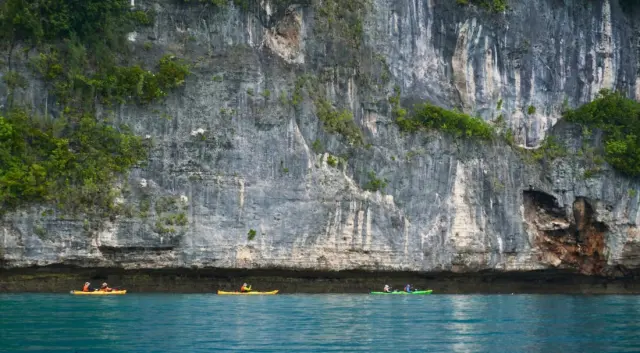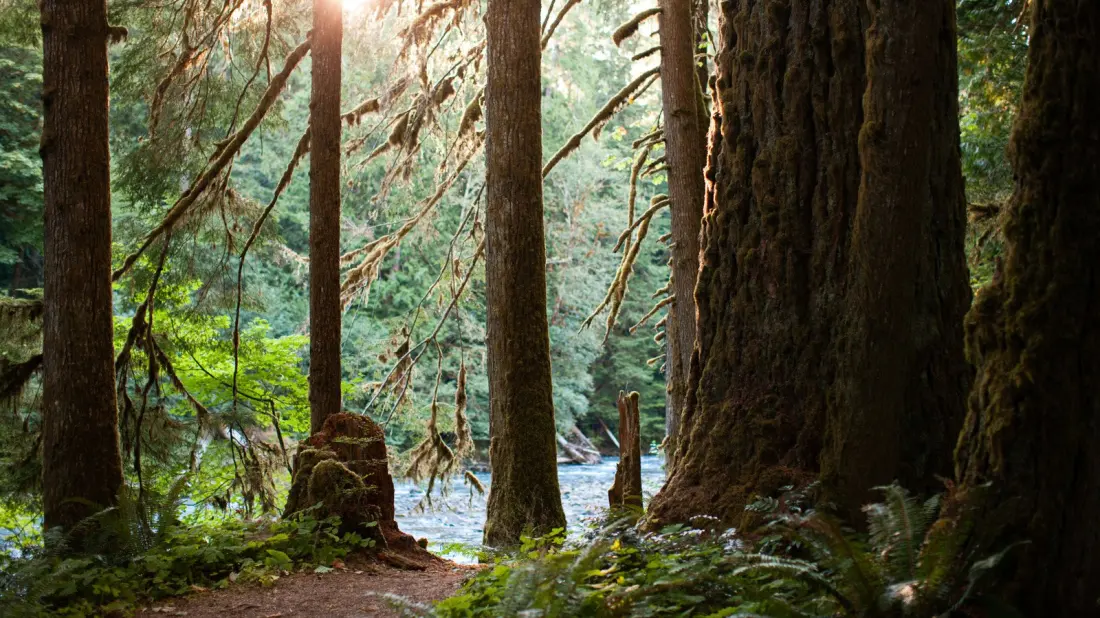
Mount Rainier gets the crowds, but the forest beside it covers far more ground. Gifford Pinchot National Forest spans roughly 1.3 million acres of southern Washington Cascades, stretching from just southeast of Rainier all the way to the Columbia River, and taking in both Mount Adams and Mount St. Helens. It was set apart as its own protected area in 1949, and it remains one of the Pacific Northwest's best value outdoor escapes — campgrounds, fishing holes and waterfall hikes without the national park queues.
The waterfalls are the headliners. Lower Falls Creek Trail is a 3.4-mile round trip that follows Falls Creek to a cascade spilling over mossy rock into a tree-ringed pool. Panther Creek Falls is the easiest win: a short dirt path (Trail 137, partially railed) just off Forest Road 65 leads to a view of twin falls with dozens of trickling streams feeding an aquamarine pool. Note the path isn't wheelchair accessible. For something genuinely off the books, Walupt Falls hides at the end of an unofficial two-mile route starting at Walupt Horse Camp on NF-2160 — the trail is faint and easy to lose, so bring GPS, an offline map, and ideally watch a walkthrough video before you go.
Then there's the volcano. On 18 May 1980, a magnitude 5.1 earthquake triggered the eruption of Mount St. Helens, killing 57 people and blowing debris 15 miles into the sky — the blast was audible over 200 miles away, and the mountain lost over 1,300 feet of height. Two years later, the Mount St. Helens National Volcanic Monument was created inside the forest, with three access points to explore the blast zone. Ambitious hikers can climb to the summit, but it's a serious undertaking even for experienced mountaineers, and you'll need a permit in advance. If you'd rather just watch, a live webcam streams the crater at all times.
Practically speaking, there's no bus or train to the forest, so a car is essential. From Seattle or Sea-Tac airport it's about two hours and 20 minutes to the northern section; from Portland the northern end is a little over three hours, though southern trailheads sit just an hour from PDX. Day use passes are available online or at Forest Service offices, and you should always check for wildfire alerts and closures before setting out.
Staying a few days is the smart move given the sheer size of the place. Options range from forest campgrounds to cabins on Vrbo and Airbnb, with small towns providing beds and meals: Packwood at the northern end, Cougar near Mount St. Helens, and Carson on the Columbia River in the south. Dogs are welcome — leashed at recreation sites and on most trails, free to roam in the wilder forest.
For travellers who love Rainier's scenery but not its crowds, this is the quieter neighbour with arguably more variety: waterfalls, old-growth, and a volcano you can stand on top of.