Shanghai's busiest district has an unlikely new place to slow down. Alila Shanghai opened in September 2024 in Jing'an, and it marks a first for the brand: instead of a cliff-top villa retreat or a beach hideaway, this is Alila's debut urban resort-style hotel — an attempt to build the feeling of an escape in the middle of one of the world's most densely packed cities.
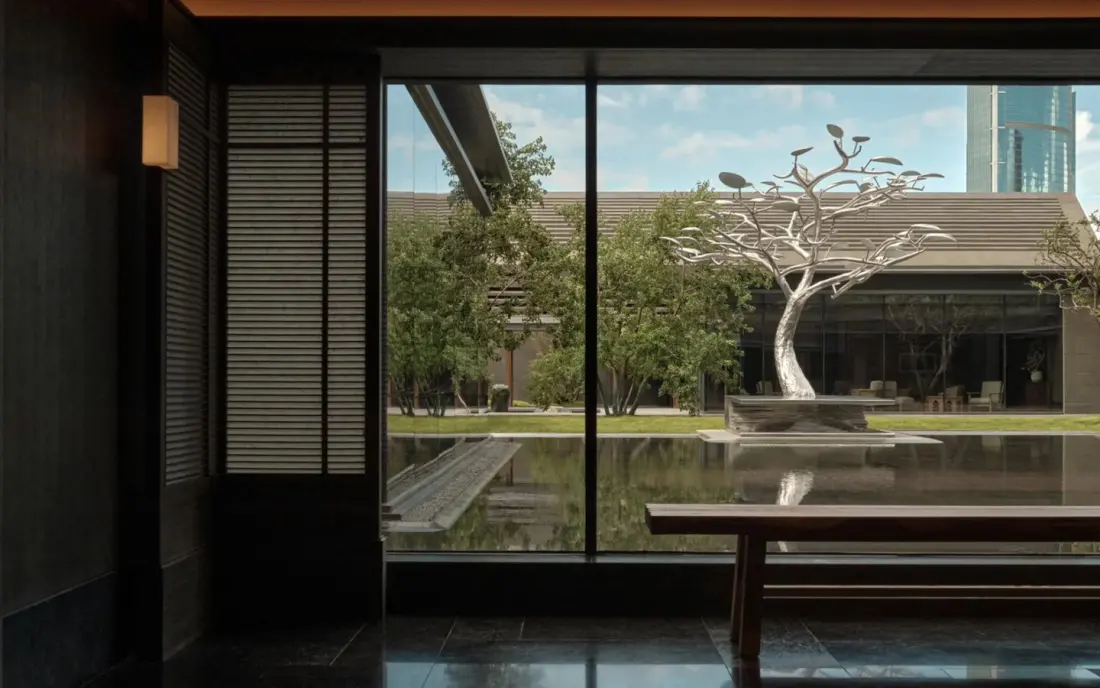
The design work went to Ju Bin, one of China's most respected interior designers, and the brief clearly leaned against the usual glass-and-chrome luxury playbook. Rough-hewn stone, timber marquetry, rattan and paper screens run through the property, mixing references to traditional Shanghai craftsmanship with clean contemporary lines. The retreat starts before you even check in: a tree-lined driveway and a water-wall entrance lead up to a fourth-floor lobby, where a still water feature sits alongside a striking 17-foot sculpture by local artist Oscar Wang. You step off Jing'an's streets and into something noticeably quieter.
The room count is modest for a city hotel at this scale — 186 rooms, of which 94 are suites, so half the property is suite stock. Even the entry-level rooms are generous by Shanghai standards at 419 square feet, a size many rivals would sell as a junior suite. At the top end, the 2,626-square-foot Penthouse Suite occupies the 37th floor and comes with sweeping city views and an elliptical, marble-lined bathtub as its centrepiece. That vertical position matters: the higher you go, the more the hotel's calm pays off with a panorama over the skyline.
For travellers, the appeal is straightforward. Jing'an puts you within easy reach of Jing'an Temple, the shopping streets around Nanjing Road West and some of the city's best dining, yet the hotel itself is built as a place to linger rather than just sleep between outings. If you have stayed at Alila properties in Ubud or the Alila Villas resorts and wondered how the brand's quiet, material-driven aesthetic would translate to a megacity, this is the answer — stone, wood and rattan instead of marble lobbies and chandeliers.
It also fits a wider shift in Shanghai's hotel scene, where new openings increasingly compete on design identity and wellbeing rather than sheer opulence. Business travellers get a calm base near the commercial district; leisure visitors get a design-led stay that feels distinctly Chinese rather than interchangeable with any global chain. Suite-heavy inventory makes it worth checking rates on the suites, since the price gap between a room and a suite may be smaller than at comparable properties. Anyone planning a Shanghai trip in 2025 who wants luxury with a softer, more local feel — and who values space per square metre — should have this one on the shortlist.