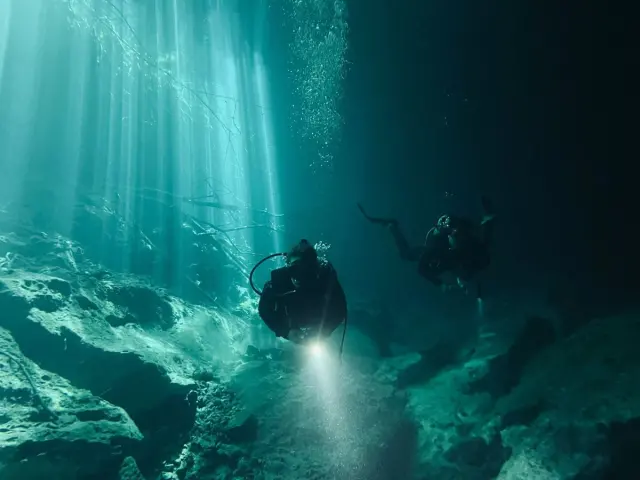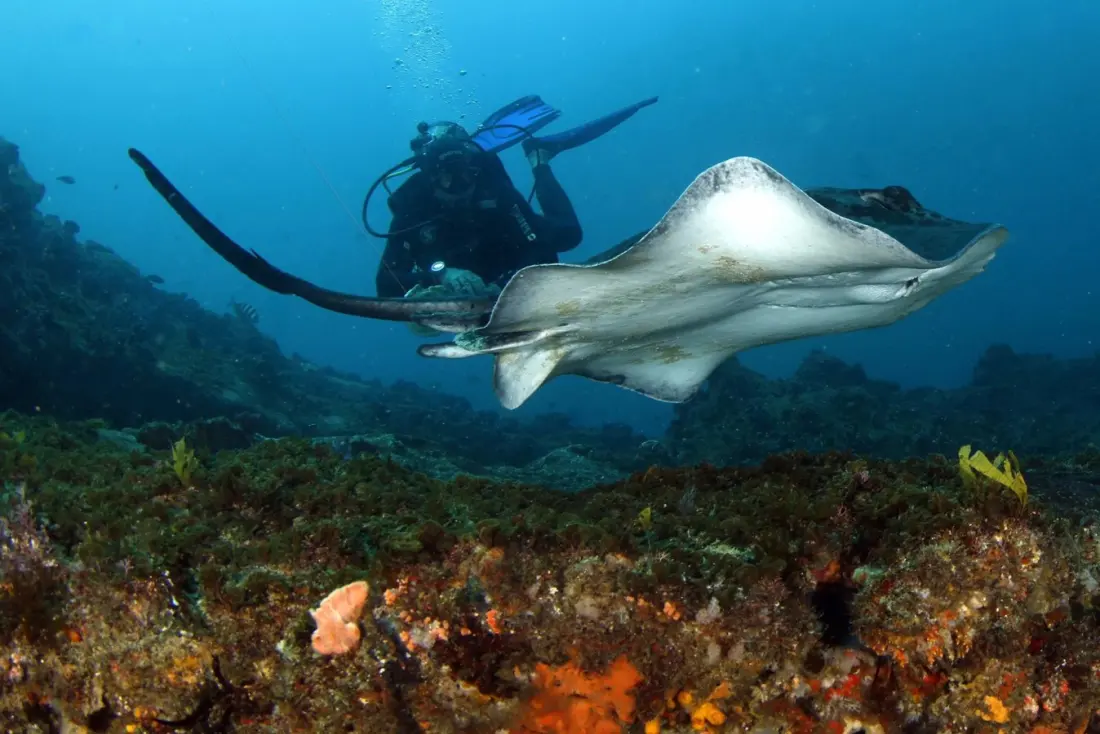
A few kilometres off the beach at Scottburgh on South Africa's east coast sits Aliwal Shoal, one of the country's most celebrated dive sites. It isn't a coral reef in the tropical sense — it's the eroded remnant of ancient fossilised sand dunes, sculpted by the warm Agulhas Current into caves, gullies, pinnacles and sandy flats over roughly 5 km. The reef starts at about 6 metres and drops to 25–30 metres in places, and since expansions in 2018 and 2019 it sits inside a Marine Protected Area covering around 670 km².
Sharks are the headline act. From July to November, ragged-tooth sharks (raggies) congregate around the reef in impressive numbers, and despite their snaggled teeth they're considered docile, making them a reliable draw for divers. Depending on the season you might also cross paths with tiger sharks, bull sharks, hammerheads or even a passing whale shark, plus turtles, bottlenose and humpback dolphins and migrating humpback whales. The Agulhas Current deserves the credit: it funnels warm, nutrient-rich water down the coastline, feeding the whole food chain.
There's wreck diving here too. The MV Produce, a Norwegian molasses carrier, went down in 1974 and lies broken across the sand at about 30 metres — a site for experienced divers, now functioning as an artificial reef. The SS Nebo is much older: it sank on its maiden voyage in 1884, and its boilers and propeller are still recognisable on the seabed.
Logistically, it's an easy trip to plan. Dive operator ScubaXcursion runs from the Premier Resort Cutty Sark on the Scottburgh beachfront, with daily boat launches to the reef — some sites take less than 20 minutes to reach. That means you can base yourself in one spot and dive repeatedly without long transfers. The operator covers the full range, from introductory dives and open-water courses to shark and wreck dives for more qualified divers.
Named sites each have their own character: The Crown and Pinnacles for walls, gullies and sponge-covered reef, Raggie's Cave for the seasonal shark gatherings, and North and South Sands, where rays and sand sharks rest on the bottom. Be aware that the same current that makes the diving so rich can also make conditions challenging — visibility and surge vary, so always take the operator's call on the day. And because the reef is protected, the rules are simple: look, don't touch, and leave everything where you found it.
For divers, this is one of South Africa's most complete underwater trips — geology, big marine life and maritime history all within a short boat ride of an ordinary beach town. Even non-divers in the group get a proper coastal holiday out of it.