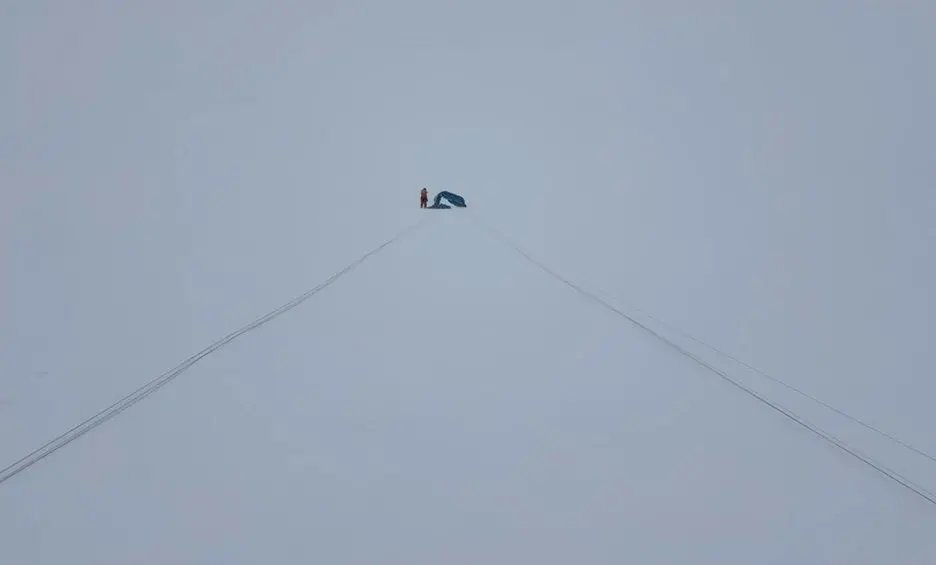
The Antarctic season kicks off later this month, and the 2026-27 lineup is packed. Around a dozen skiers, kite teams and paddlers have announced expeditions, and even the shortest of these trips — the classic Last Degree ski — runs close to $100,000 because of the chartered flights needed to reach the ice.
The bulk of the solo skiers will start at Hercules Inlet, the standard launching point for South Pole attempts. It's a 1,130km grind at roughly 20km a day, pulling everything you need on a sled. Five skiers are lined up here: Britain's Nathan Lumb (who trimmed an original round-trip plan after funding fell short), India's Neeraj Choudhary, who is chasing a second-ever solo unsupported Indian ski to the Pole, Americans Lucas Czarnecki — who promises to livestream his entire expedition as "South Signal" — and Meghan Buchanan, first out of the gate on November 12, plus Germany's Dirk Langer.
Two longer starts add extra distance. Max Worsley, son of Henry Worsley, who died after his Antarctic expedition in 2015-16, and Norway's Martin Nesse will set off from Berkner Island, stretching the route to about 1,400km. James Garnett and Marius Rehn will use the Messner start, 911km out.
The headline attempt belongs to Satish Gogineni. After becoming the first Indian to ski solo to the South Pole last season, he returns with a 2,000km solo crossing from the Filchner-Ronne Ice Shelf edge to the Ross Ice Shelf via the Pole — billed as a world first, though it would still fall short of Borge Ousland's 2,845km solo crossing in 1997. The big risk is sled weight: Gogineni is hauling 181kg, and Colin O'Brady's longer 2,800km attempt last year collapsed after 100 days, partly because heavy loads forced him to double-carry, moving 15km for every 5km of progress.
Away from the solo skiers, the "Antarctic Valkyries" — Mardi Philips, Ida Olsson and Nia Owens — will kite-ski 2,500km from Queen Maud Land to the Pole of Inaccessibility and on to the South Pole, aiming to be the first all-female team to reach that remote point. A Spanish team brings a 15m modular wind-sled pushed by 20 kites (up to 150 square metres) on an 85-day, 3,400km run from near Novolazarevskaya Station to Concordia at Dome C. And in January, three Argentine kayakers will paddle roughly 900km along the Antarctic Peninsula coast from Esperanza Base to San Martín Base over 30 to 40 days.
You don't need a six-figure budget to follow along — several of these expeditions will publish daily updates and, in Czarnecki's case, livestream from the ice. For anyone dreaming of the far south, this season is a good window into what's still possible on a continent where, even now, records are being redrawn.