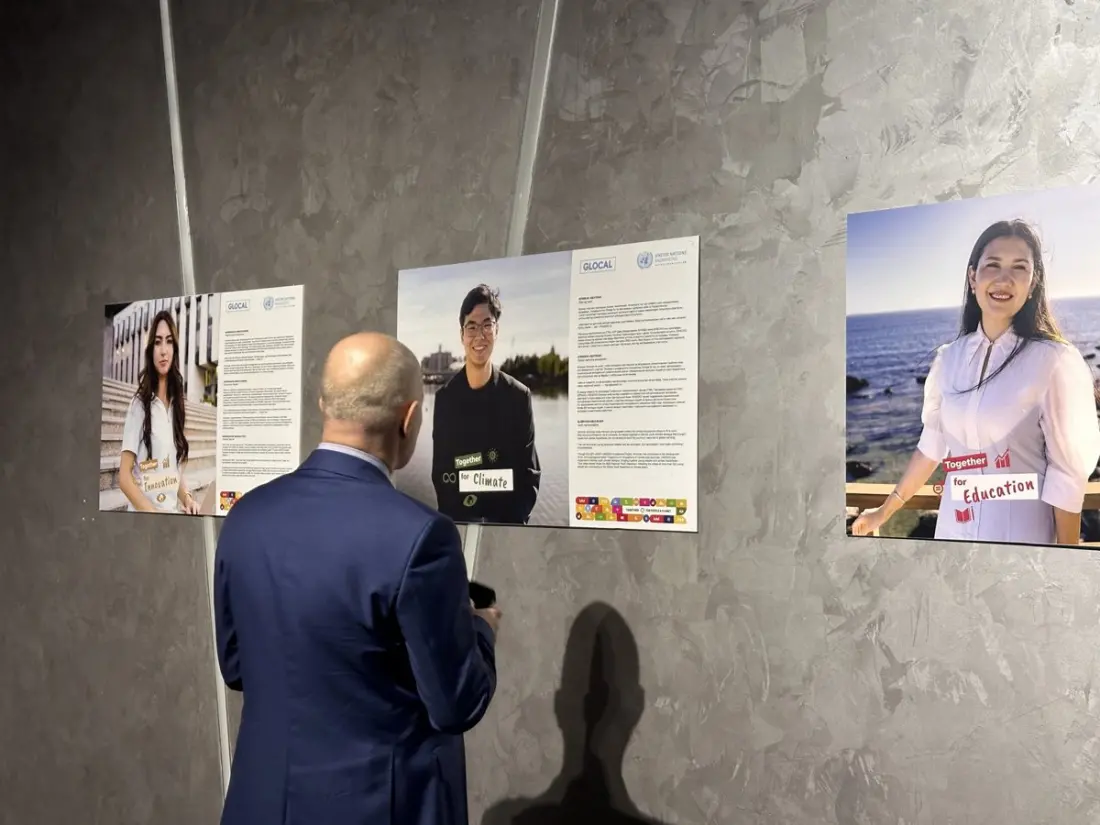
A student turning polluted air into printer ink, a teacher getting kids hooked on books again, an entrepreneur pulling drinking water out of thin air with solar power — these are just three of the stories now on display at the National Museum of Kazakhstan in Astana.
The United Nations photography and multimedia exhibition, called "GLOCAL: Global Goals. Local Lives," opened on October 21 and runs until November 4. It profiles 30 people across the country whose everyday work puts the UN's Sustainable Development Goals into practice: young inventors, educators, doctors, environmental campaigners and business owners from Astana, Almaty, Shymkent and Kyzylorda, plus the Karagandy, Akmola, Turkistan and Mangystau regions.
Rather than a dry policy show, the exhibition is organised around the five pillars of the UN's 2030 agenda — people, planet, prosperity, peace and partnership — and focuses on how global targets land in real communities, from environmental clean-ups to education and healthcare projects. Speakers at the opening included UN Resident Coordinator Sarangoo Radnaaragchaa, who argued that sustainable development is built with communities rather than delivered to them, and First Deputy Foreign Minister Yerzhan Ashikbayev, who linked the show to Kazakhstan's wider diplomatic push on water security and a proposed UN-backed international water organisation.
The timing is no accident. The exhibition sits under the UN Sustainable Development Cooperation Framework for 2026–2030, which covers empowered institutions, an inclusive economy, environmental sustainability and social cohesion. It also follows the launch of the UN Regional Centre for the Sustainable Development Goals for Central Asia and Afghanistan, based in Almaty — a sign that Kazakhstan is positioning itself as the region's hub for development cooperation.
For travellers, the exhibition is a genuinely good reason to visit the National Museum this fortnight. It doubles as an unusually intimate introduction to the country: instead of the usual steppe-and-silk-road framing, you get portraits of Kazakhs solving problems in their own cities and villages, from the Aral-adjacent south to the industrial centre. Even if you miss the run, the museum itself — the largest in Central Asia — is worth a half-day, and the exhibition's themes map neatly onto trips many visitors are already considering, such as Baikonur, the Mangystau canyons or the Aral Sea region, where water and environment issues are impossible to ignore.
If you are in Astana before November 4, entry is combined with the museum's regular collection, and the surrounding area near the city's main axis makes an easy cultural loop with other sights. It is a rare chance to see a global agenda told through 30 local faces — and to come away knowing more about modern Kazakhstan than most guidebooks will teach you.
Story via The Astana Times.