Some fossils are dug up. This one was found in a drawer. A new species of carnivorous dinosaur has been identified from a skull that sat unstudied in the Natural History Museum in London for over a century — and it came from one of Britain's favourite holiday islands.
The fossil was first recovered at Sudmoor Point, near Brook on the southwestern coast of the Isle of Wight, and bought by the museum from Reverend R. W. Hooley in May 1924. Only now, after micro-CT scans and detailed anatomical comparisons, has it been recognised as something new. Researchers led by Cassius Morrison of University College London named it Invictibellatrix amberina — Latin for "unconquered female warrior" — and published the findings in Royal Society Open Science.
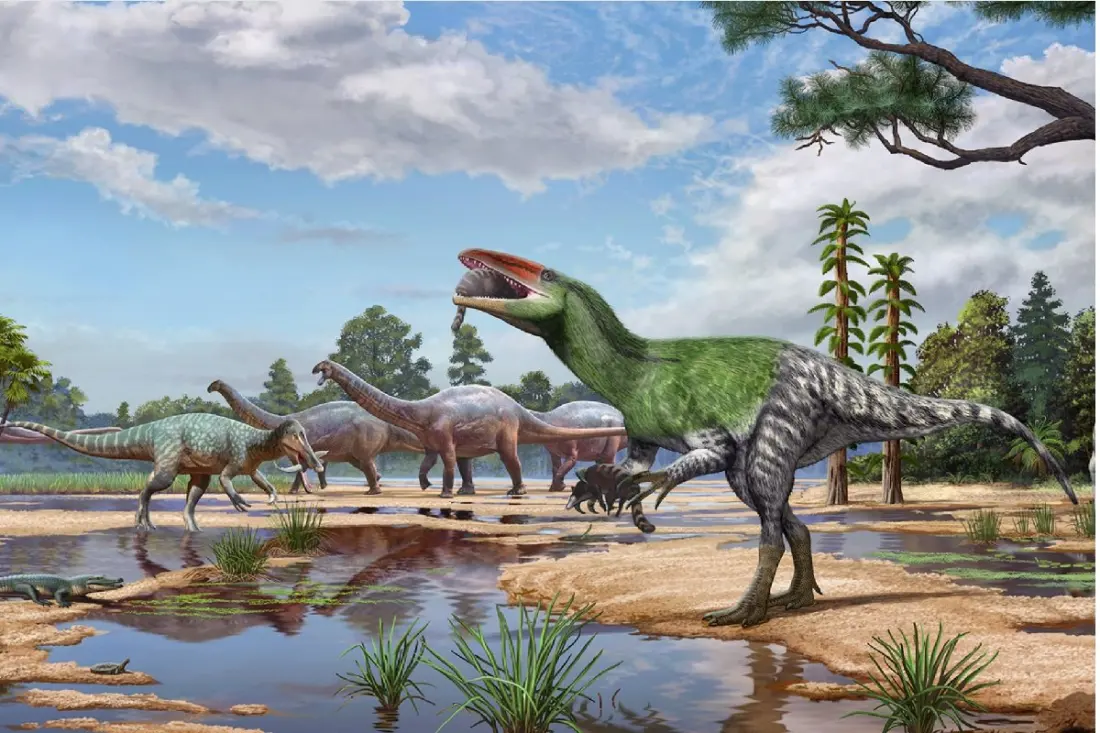
The creature was a megaraptoran: a bipedal, possibly feathered predator around three to four metres long and 1.5 metres tall, armed with curved claws up to 20 centimetres long. It lived roughly 120 million years ago, during the Early Cretaceous, when the area that is now the Isle of Wight was part of the Wessex Formation, one of Europe's richest dinosaur-bearing rock units. Researchers suggest that, unlike the much larger T. rex, which hunted big prey, a human-sized animal would have fit squarely within this dinosaur's prey range — a hypothetical comparison, to be clear, since humans appeared millions of years after both predators vanished.
Why should travellers care? Because the Isle of Wight is regularly called the dinosaur capital of Britain, and this discovery underlines why. The island's south-west coast — Compton Bay, Brook, Brighstone and the cliffs around Sudmoor Point — keeps eroding and regularly exposes new fossils. Visitors can walk the beaches looking for fragments, join guided fossil hunts run by local experts, or see specimens at Dinosaur Isle, the museum in Sandown. There's even a life-sized model trail of prehistoric creatures at Blackgang Chine, the island's quirky amusement park.
The story is also a reminder that discoveries don't always happen in the field. As co-author Paul Barrett of the Natural History Museum notes, historic collections still hold plenty of unidentified species — millions of fossils collected over two centuries, waiting in drawers. Some of them may have come from the same stretch of coastline you can walk in an afternoon.
For anyone planning a UK short break with a difference, the Isle of Wight offers a rare combination: fossil-hunting beaches, a dinosaur museum, dramatic chalk cliffs and, if this find proves anything, the chance that something remarkable is lying right under your feet.
Story via Colombia One.