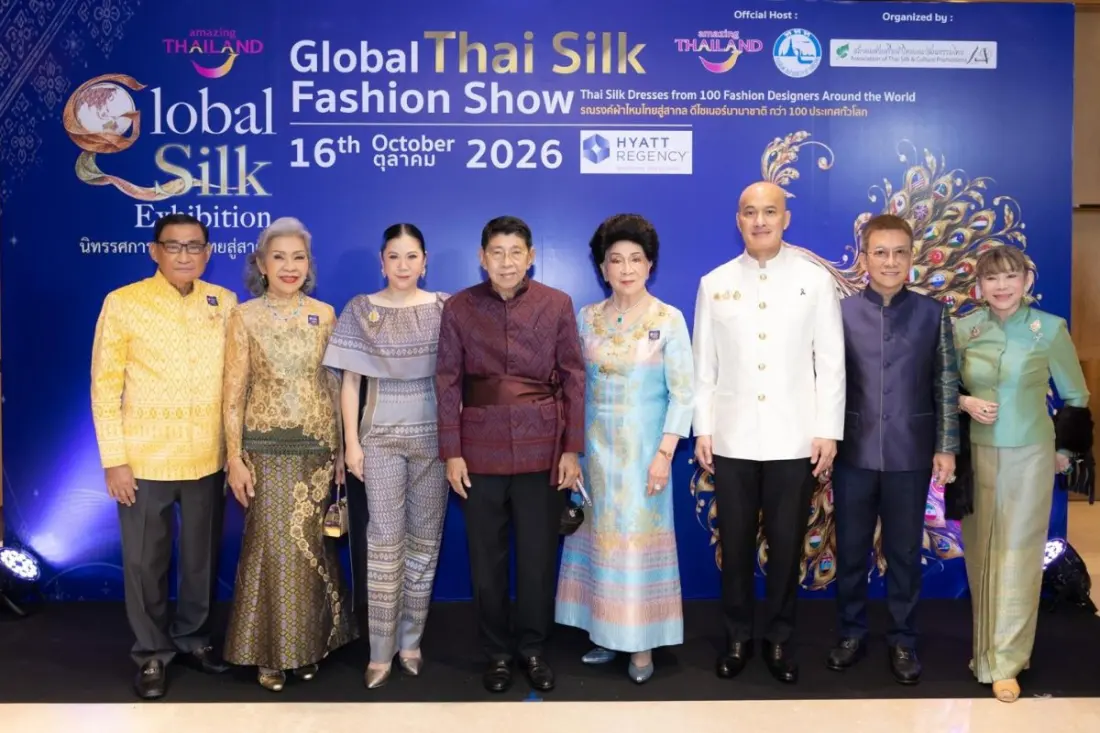
A single fabric, half a kilometre of it in black alone, became the common thread connecting six continents at the Amazing Thailand Global Thai Silk Exhibition in Bangkok. The Tourism Authority of Thailand, working with the Thai Silk & Culture Club Association, staged the show as part of the cultural programme for the 2026 Annual Meetings of the International Monetary Fund and the World Bank Group — a deliberate choice to put Thai heritage in front of a global economic audience.
Designers from Myanmar, Sweden, the United Arab Emirates, Morocco, the United States and Guatemala were each handed the same starting point — traditional Thai textile — and asked to run with it through the lens of their own culture.
The results range widely. Myanmar's Mogok Pauk Pauk drew on the shared cultural history between her country and Thailand for a contemporary take on sustainability. Swedish designer Göran Afeldsson, with more than four decades in fashion, explored how Thai silk's sheen plays against Scandinavian simplicity. From the Gulf, Emirati designer Feryal Albastaki reimagined traditional elements in a modern lens while celebrating Emirati craft, framing her work as a commitment to keeping heritage alive even as techniques evolve.
Morocco's Fadwa Sbari brought desert shadows and gold tones into the mix, pairing Moroccan craftsmanship with modern femininity and rich detailing. Filipino-American couturier Oliver Tolentino, representing North America, took on an unexpected pairing of denim and Thai silk, balancing the fabric's ornate richness against work-class grit and individual expression. And from Guatemala, Jan Carlos Solórbolla combined black Thai silk with recycled jute textile, using fabric as a way to talk about mourning, devotion and transformation.
Beyond the looks, there was symbolism. The colour palette carried meanings paying tribute to Her Majesty Queen Sirikit and the Royal Highnesses Princess Bajrakitiyabha and Princess Sirirasmi Boonraj — the royal family's long patronage of Thai silk remains central to how the industry tells its story.
The underlying point of the exhibition: Thai silk is more than a traditional fabric. It's a medium for storytelling and cultural exchange, and giving international designers free rein with it is a smart way to keep a centuries-old craft in the contemporary conversation.
For travellers, it's a nudge to look beyond the standard souvenir market. Bangkok's silk shops, Jim Thompson's house-museum and the weaving villages around the northeast (Isan) offer a much deeper dive into the fabric's history, and a hand-woven piece bought at source carries a story no airport shelf can match. With the city set to host the IMF and World Bank gatherings, expect more heritage-focused cultural programming around town in the run-up — a good excuse to plan a trip around it.