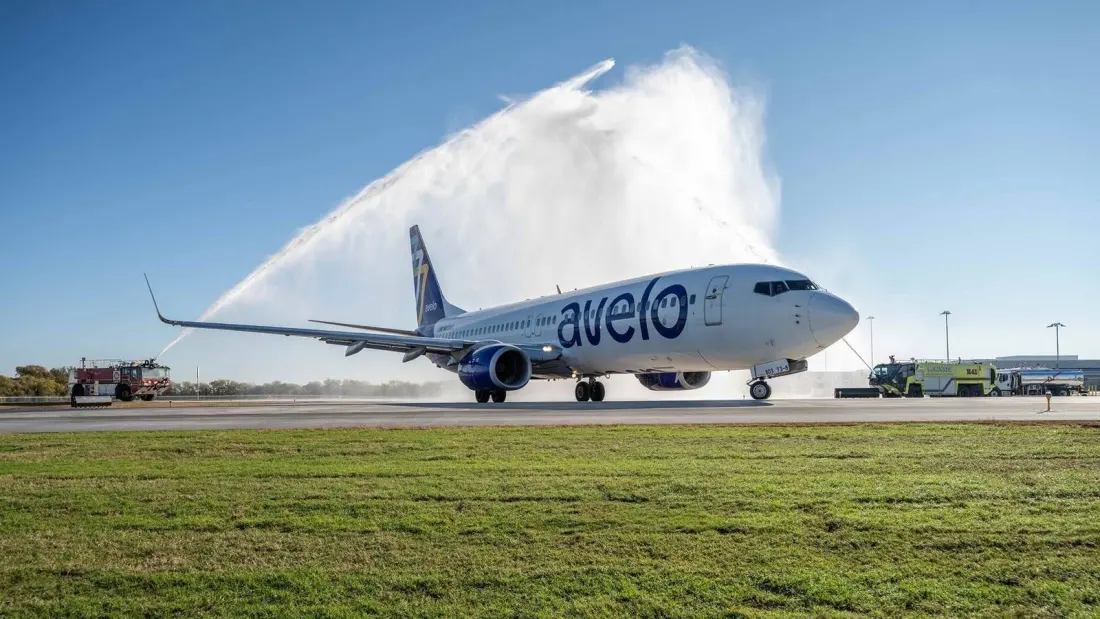
North Dallas has a third airport in the scheduled-flight game, and it's off to a startling start. Dallas McKinney National Airport (DTX), a general aviation field for four decades, welcomed its first commercial service this month when ultra-low-cost carrier Avelo began flying out of a brand-new terminal — and within weeks it has become Avelo's second-busiest airport in the entire network.
Avelo is the first and so far only scheduled airline at McKinney, which sits north of the Dallas/Fort Worth Metroplex. The City of McKinney spent $72 million on a new passenger terminal, approved in 2025, and the airport became the first in Texas to earn an FAA Part 41 Airport Operating Certificate since 2005. The airline clearly likes what it sees: it launched nonstop service to Fort Myers on November 11, followed by Las Vegas and Orlando the next day, with Fort Lauderdale and Tampa starting November 19. Six more routes — Atlanta, Denver, Sarasota, Nashville, New Orleans and West Palm Beach — land on December 16 and 17, taking the network to 11 nonstop destinations before Christmas.
The logic is straightforward. Avelo targets leisure travellers and North Texas's fast-growing northern suburbs, and McKinney offers a far less chaotic alternative to Dallas/Fort Worth (DFW) or Dallas Love Field (DAL). Most routes point to Florida and Nevada, the kind of sun-and-fun markets Avelo thrives on. Cirium data suggests the bet is paying off: by the first quarter of 2027, McKinney is projected to host 539 Avelo departures, overtaking Wilmington, Delaware as the airline's number-two station behind its New Haven, Connecticut base.
Not everyone is convinced, though. Dallas hometown carrier Southwest has signalled no interest in serving McKinney, saying the numbers don't stack up — so for now, Avelo has the airport to itself.
For travellers, this is a genuinely useful option if you live in Collin County or anywhere along the northern edge of Dallas. Instead of the DFW mega-hub or Love Field's parking scrum, you get a small terminal, quick security and low fares to beach and city-break destinations — with multiple weekly frequencies on most routes and twice-weekly service on the smaller ones. Just don't expect connections: this is point-to-point low-cost flying, so budget for bags and check in early if you want a decent seat.
The airport still houses plenty of business aviation — Texas Instruments and Toyota both base fleets there — but the commercial side is now the story to watch. If the traffic holds, McKinney could reshape how North Texans fly to Florida, and possibly prompt other carriers to reconsider a market Southwest currently dismisses.