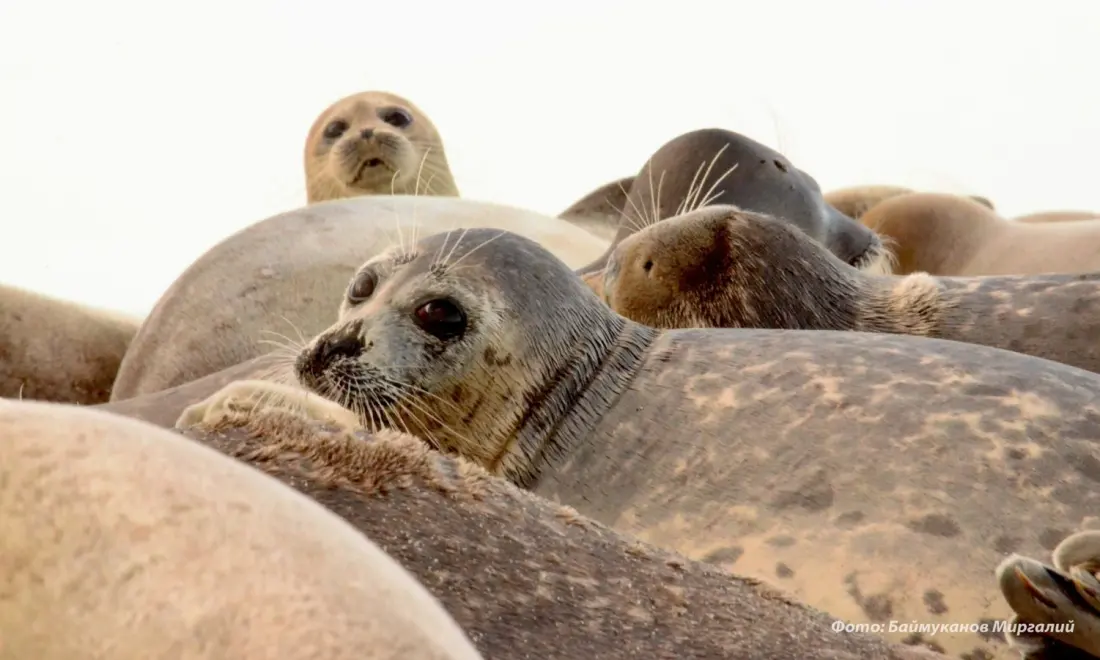
The Caspian Sea has been shrinking since 1995, and nowhere is that more visible than along Kazakhstan's northeastern coast — or more damaging for the seal species that lives only there.
Assel Baimukanova, a researcher at Kazakhstan's Institute of Hydrobiology and Ecology with 13 years and 30-plus expeditions studying the animals, shared stark numbers with The Astana Times. The Northern Caspian's level has dropped 2.28 metres since 1995. Along the coast from the Ural River mouth to the Buzachi Peninsula, the shoreline has retreated an average of 44 kilometres since 1995 — and by up to 175 kilometres near Kaydak Bay. Between spring 2022 and spring 2023 alone, the coast moved 23 kilometres westward. The total area of islands has shrunk more than 15-fold.
For the seals, that means losing the places they rest, moult and prepare for winter. At the Durnev Islands in Komsomolets Bay, researchers counted roughly 25,000 seals in 2009, about 20,000 in 2011, around 300 in 2016, and just 69 by 2019. By 2021 the islands had merged with the mainland and disappeared entirely. Aerial counts on the region's remaining haul-out islands fell from 62,105 seals in spring 2022 to 44,573 in autumn 2023.
Ice is the other problem. Caspian seals give birth and raise their pups on the northern sea's winter ice, which climate change is steadily eroding. Human pressures pile on: fishing nets, pollution, shipping, tourism and offshore oil and gas. Of 395 seal remains examined between 2019 and 2023, 9.4% showed signs of entanglement in fishing gear. Researchers have also hauled more than 36 tons of marine waste off the coast over five years, including about 17 tons of abandoned nets.
The health warnings are grim. Seals once lived to 50; the oldest found in recent studies was 32, with few past 20. They feed mainly on gobies rather than commercially valuable fish, and pollution appears to weaken their immune systems.
There is some action on paper. Kazakhstan listed the seal as rare and endangered in 2020, created a dedicated protected area in 2024, and has a joint conservation plan with Russia plus a planned rehabilitation centre. But Baimukanova stresses the sea is shared by five countries — Kazakhstan, Russia, Azerbaijan, Turkmenistan and Iran — and no single state can save the species alone.
For travellers, this matters if you're drawn to wild, off-the-beaten-track corners like the Caspian's Mangystau coast or the shallow northern sea. Eco-tourism here is still nascent, and the region's changing shoreline — retreating ports, vanishing islands — is itself a dramatic, sobering thing to witness. Responsible operators and any future seal-focused tourism will depend on the habitat surviving, which makes low-impact travel and support for local conservation efforts genuinely consequential. If you go, treat the coast as fragile: stick to established routes, leave no waste, and don't disturb haul-out sites you may be lucky enough to spot from a distance.