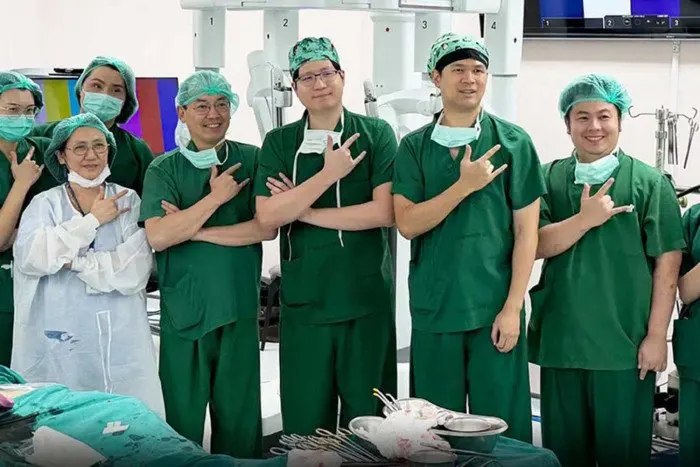
A Bangkok hospital has pulled off a surgical first. Rajavithi Hospital, which answers to Thailand's Ministry of Public Health, has completed the country's first minimally invasive, multi-vessel coronary artery bypass using robotic assistance — meaning several blocked heart arteries were bypassed in one operation, without the usual large chest incision.
The procedure, described as robotic internal mammary artery harvest with total coronary revascularisation via anterior thoracotomy, is a mouthful, but the practical upshot is simple. Instead of the conventional open-heart approach — an incision of 20 to 25 centimetres through the breastbone — surgeons used robotic tools through much smaller access points. Patients experience less pain, fewer complications, faster recovery and shorter hospital stays, according to the hospital.
Thailand's Department of Medical Services has been quick to flag the milestone. Its director-general, Dr Weerawut Imsamran, called Rajavithi the leading institution for robotic surgery within the department and the first government hospital in the country to take the technology on. The hospital has now carried out more than 1,600 robotic-assisted operations in total, spanning prostate, liver, colorectal and tongue-base cancers, tonsil disorders, uterine fibroids and heart disease. The new cardiac work builds on its existing Robotic Cardiac and Thoracic Surgery Project.
Hospital director Arkom Chaiwerawattana highlighted one of the most impressive figures: up to four coronary arteries can be bypassed in a single robotic operation. That puts the technique in genuinely serious territory — multi-vessel bypass is one of the most common and demanding heart surgeries worldwide, and doing it robotically through a small chest opening rather than cracking the breastbone is a meaningful step for patient recovery times.
Strictly speaking, this is medical news rather than a holiday story, so it won't reshape your itinerary. But it does say something useful about Bangkok as a place. Thailand has spent years building a reputation as one of Asia's top destinations for medical travel, drawing patients from the Middle East, Europe and North America for everything from routine check-ups to complex surgery, usually at a fraction of home-country prices. A public hospital reaching this level of robotic cardiac capability — not just the famous private groups like Bumrungrad or Bangkok Hospital — signals that the country's broader medical system is investing in advanced care too.
For travellers, the relevant takeaway is reassurance rather than a booking: if you're a long-stay visitor, retiree or digital nomad in Thailand with cardiac risk factors, high-end surgical capability now sits comfortably within the public system, and the medical-tourism infrastructure around it — interpreters, international patient offices, recovery-friendly hotels — is well developed. And for anyone specifically considering surgery in Thailand, robotic procedures at public institutions may come with shorter waits and lower costs than equivalents in Europe or the US. It's worth noting the source coverage is a hospital and ministry announcement, so long-term outcome data for this exact technique will take time to accumulate.
Story via Bangkok Post Life.