Desmond Macgcnaimhshi, an Irish musician who spent nearly three decades as a fixture of Kathmandu's live music scene, died on 24 October at his home on Kimdol Hill, below the sacred stupa of Swayambhunath. He was 85, and had played his final set just five days earlier at Ramsterdam in Boudha, the venue he had helped launch and where he performed every week for the past 15 years.
His life read like a map of the old overland routes. Born in the Gaeltacht, the Irish-speaking region scarred by the nineteenth-century famine, Desmond played in Dublin's early 1960s rock scene with a band called The Caravelles before joining the merchant marines as a painter. He jumped ship in Morocco and kept moving — through Sri Lanka, Goa and India, where he met and married Joan Jacobs in 1974. The couple settled in Kathmandu in the late 1990s, drawn by Buddhist teaching and what they saw as the valley's sense of the sacred.
In Kathmandu he opened a recording studio on Kimdol and played with bands including Too Loose to Trek, Phil'n the Blanks and Usual Suspects, with regular slots at The Irish Pub, Upstairs, Spam's and New Orleans. He wrote most of his own material — blues-tinged songs about people living on the margins, delivered with what friends describe as Irish wit and a pessimism he could always laugh at. One song, 'Can't even give it away', was inspired by an ageing sex worker he had seen on a roadside in Italy. He also recorded originals at the studio of his Italian friend Beppe, with whom he once played 45 gigs in two months on Elba.
Kathmandu winters were never for him. For thirty years he decamped each winter to Koh Payam, a Thai island where he had helped build a second music scene — an open-mic circuit that moves from venue to venue nightly, drawing international musicians who still treat him as something of a founding father.
At home he was quietly shaping the next generation. Young Nepali guitarists gravitated to his Friday nights at Ramsterdam, among them Benjamin, the venue owner's son, who went from student to stage partner. Regulars describe evenings that ended with crowds on the floor dancing.
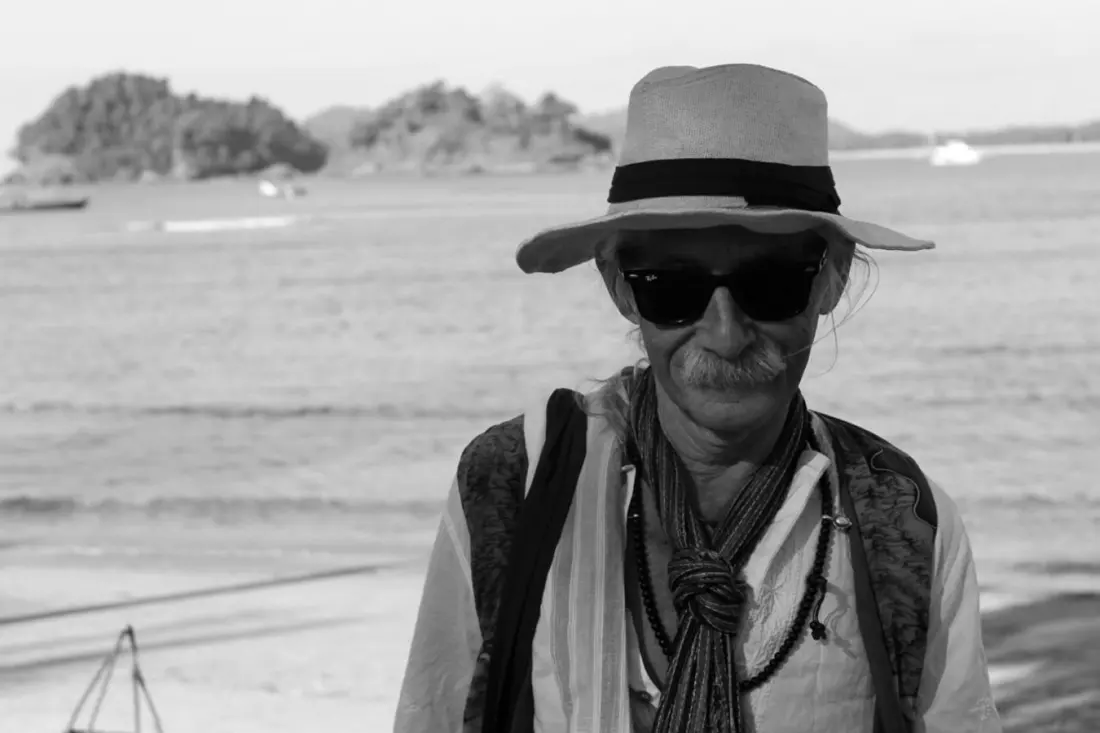
Desmond belonged to a dwindling breed: the 1970s hippy-trail expats who never really went home. For travellers wandering through Boudha or climbing towards Swayambhu, he was part of the city's texture — the man with the grey ponytail and the moustache, holding court at the farmers market on Saturdays or setting up his guitar on Mahankal Road. His death closes a chapter of Kathmandu's expat history, but the scenes he built in both Kathmandu and Koh Payam carry on, which is arguably the best kind of monument a travelling musician can leave. Reported by Nepali Times.