Documentary filmmaker Karina Holden came home from Greenland last summer with the outer layer of her eyeballs peeling off. Weeks of filming at -40°C in katabatic winds stripped her corneal epithelium — and when she then slipped into the ocean off Sydney for a swim, the damage revealed itself in spectacular fashion. That's the level of commitment behind Ages of Ice, an upcoming natural-history series about the poles and the scientists racing to understand how climate change is rewriting them.
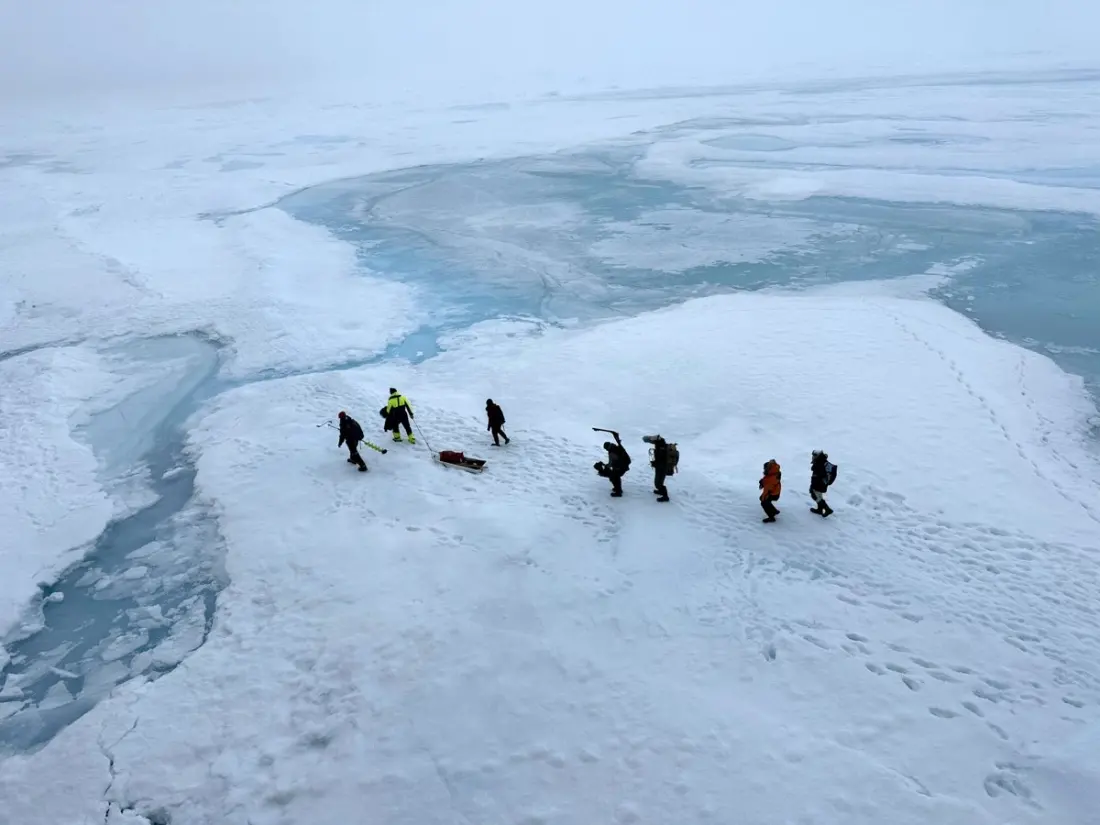
Holden and small crews travelled to Antarctica twice, the Arctic three times, the European Alps and the Canadian Arctic, embedding with more than a dozen researchers. The series even ventures beyond Earth, covering NASA's Europa Clipper mission to an ice-covered moon of Jupiter — a neat reminder that ice might be where we find life elsewhere. Getting to remote locations meant jumping aboard research vessels and sweet-talking polar cruise operators for spare berths. One German cameraman crossed the Greenland ice sheet on skis: 535km over 30 days, hauling 100kg sleds, filming while skiing up to 13 hours a day.
Three stories from Holden's field diaries stand out. In Cambridge Bay (Ikaluktutiak) on Canada's Victoria Island, the sea ice that once froze solid in October now can't carry a skidoo until December — villagers have died falling through. There she filmed UK startup Real Ice, whose volunteers pump seawater onto the ice surface so it refreezes and thickens; three years of field trials have added half a metre of ice, with plans for autonomous drone networks funded by carbon offsets. In Svalbard at 80°N, recording from a hydrophone, the team captured the Arctic's 'biophony' — bearded seals singing alien-like songs to find mates, belugas navigating breathing holes by sound. As shipping lanes, seismic surveys and trawlers open up the once-silent Arctic, that soundscape is under threat, and WWF is campaigning for quieter ships and protected corridors. In Greenland, Holden camped for five nights atop 2km of ice with Welsh glaciologist Professor Alun Hubbard, where every exhaled breath froze to the tent walls.
There's a Sydney tie-in too: the Powerhouse Museum is planning an exhibition on the scientists featured, aiming to show STEM students that polar science offers careers in robotics, geology and microbiology 'at the ends of the earth'.
Why should travellers care? Because polar expeditions are among the fastest-growing — and most fragile — corners of adventure tourism. Whether you're eyeing an Arctic cruise past drift ice and walruses or a science-focused voyage to Greenland, this series will show you what's actually happening under the ice you're sailing over, and the researchers whose work your visit sometimes helps fund. It arrives framed around hope and innovation rather than doom, which makes it useful viewing before booking any trip above 66°N. Ages of Ice is one to watch — ideally indoors, with your eyeballs intact.