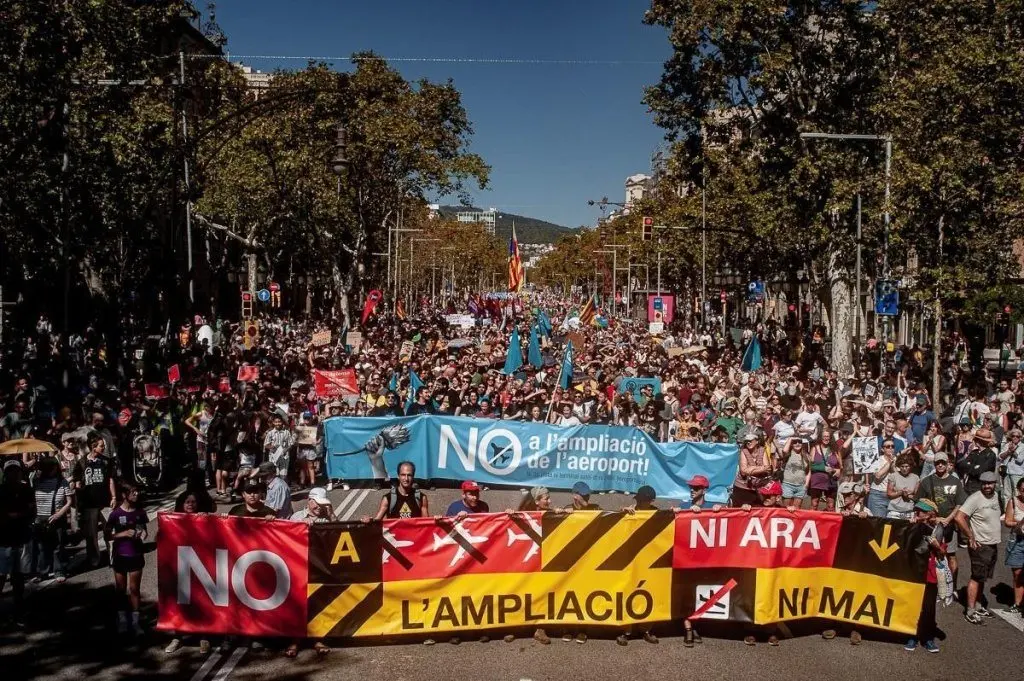
Thousands of protesters filled the streets of Barcelona, Ibiza Town and Palma de Mallorca on the same Sunday, united against plans to grow the airports serving three of Spain's biggest tourist hotspots.
In Barcelona, the march set off from Passeig de Gràcia and wound through the centre to Plaça de Sant Jaume under the slogan 'No to the expansion, not now nor ever'. Police counted roughly 5,500 participants; organisers claimed over 30,000. The protest, coordinated by the Zeroport platform with backing from more than 250 groups and around 130 academics, included cyclists and tractors arriving from surrounding areas. Opponents argue that expanding Josep Tarradellas Barcelona-El Prat Airport will worsen overtourism, housing pressure and climate impacts, and threaten the ecologically sensitive Llobregat Delta, including protected land at La Ricarda.
The timing matters. Days earlier, Spain's Cabinet approved DORA III, Aena's 2027-2031 investment programme worth nearly €13 billion across its airport network. Barcelona-El Prat gets about €1.76 billion of that, mostly for terminal and airfield upgrades — but crucially, not for the controversial 500-metre runway extension or a new satellite terminal. Around €191 million is earmarked for preparatory work on that possible expansion, reviving a fight that first flared in 2021 before the previous plan was shelved. The airport already handled almost 57.5 million passengers in 2025.
On the islands, the picture is similar. Ibiza saw one of its biggest demonstrations in years, with police estimating 4,500-5,000 marchers. Its airport is lined up for around €229 million of investment, including a jump from 17 to 32 boarding gates and a new non-Schengen area for UK and US routes. In Palma, protesters marched under 'No more expansion, no more promotion', responding to more than €620 million planned for Palma and nearby Son Bonet, which would lift annual capacity from about 34.27 million to 35.67 million passengers. Campaigners there want to go further: fewer flights, curbs on private aviation, an end to night flights, and a formal Balearic say in how the islands' airports are run.
Why should travellers care? Because this debate could shape how your next Spanish holiday looks. If locals succeed in capping flights, routes may shrink or prices rise, especially in summer. If airports expand, visitor numbers could keep climbing — and with them, the anti-tourism sentiment already visible across Spain, from rental restrictions to street protests. Anyone planning a trip to Barcelona or the Balearics in the next few years is visiting destinations actively wrestling with how much tourism is too much. Travelling shoulder-season, staying in licensed accommodation and supporting local businesses beyond the obvious clusters are simple ways to be part of the solution rather than the problem.
The story is still developing: the runway extension needs environmental and political sign-off, and Catalan and Balearic authorities remain divided. Expect this argument to run well beyond 2027.