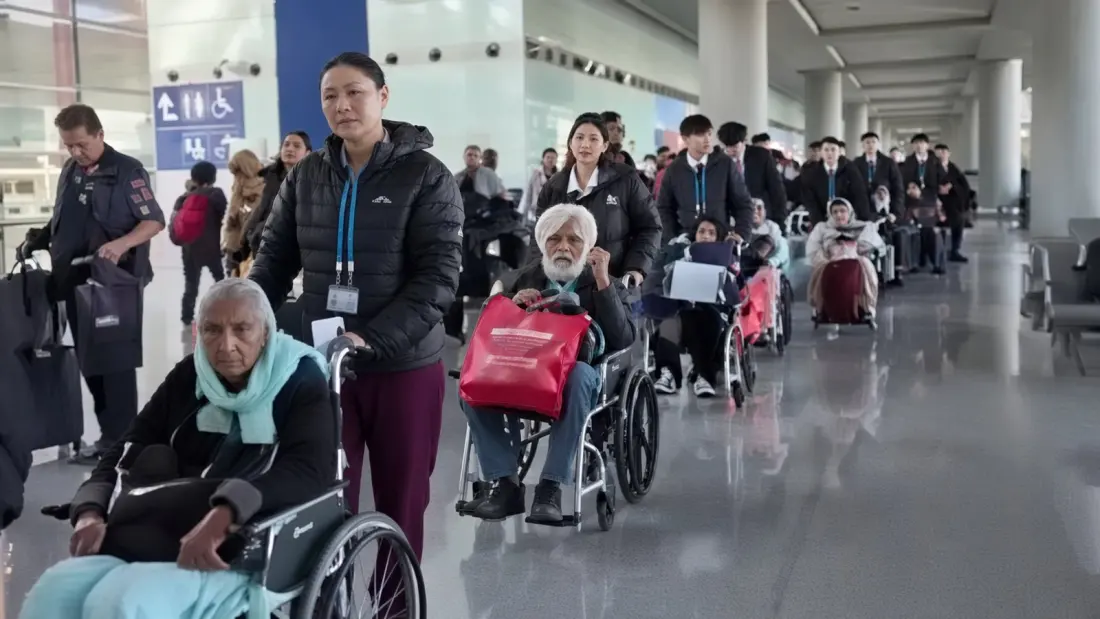
A video of around 20 wheelchair passengers lining up for a Beijing-to-Toronto flight has sparked a heated debate online — because, according to witnesses, many of the same travellers strolled off the plane at their destination, collected their bags and browsed duty free on their way out.
The clips, filmed at Beijing Capital airport on November 9-10, gained traction after a Reddit post flagged them, with Hong Kong's i-CABLE reporting that similar scenes played out on departures to both Toronto and Vancouver. The accusation levelled at the passengers: faking mobility problems purely to exploit priority boarding, shorter queues and personal escorts through the terminal.
If this sounds familiar, that's because the 'wheelchair hustle' is well documented. In the US, Southwest Airlines' old open-seating policy was the classic enabler — grabbing a wheelchair meant boarding first, which meant first pick of seats. Videos circulated of passengers filming themselves pretending to hobble through the gate, then enjoying an entire row to themselves. Frontier's CEO Barry Biffle estimated each wheelchair request cost his airline $30-35, and Southwest's own COO Andrew Watterson admitted wheelchair use dropped noticeably after assigned seating rolled out on January 27 — a wry comment circulating online noted how much 'healthier' Southwest's passengers suddenly became.
Not every suspicious-looking request is a scam, though. Some routes genuinely need more assistance than others: a flight packed with elderly parents visiting family abroad is very different from a Monday morning business shuttle. Long terminal walks, language barriers and tight connections are real reasons to request help. There have been reports of more than 60 wheelchairs prepared for a single Taipei departure to the US, and wheelchair requests on some Air India long-haul routes running close to 30% of the cabin. In Beijing specifically, the airport offers an escort service that can guide you without taking a wheelchair out of circulation.
Why should a traveller care? Because the queue-skippers aren't just gaming the system — they're delaying people who genuinely need it. Assistants, chairs and staff are finite resources, and every unnecessary request means a disabled passenger waiting longer at the gate after deplaning. Airlines are slowly rethinking boarding incentives (assigned seating has visibly dampened fake requests), but if you or a relative legitimately need help, book it in advance, know your rights, and don't feel awkward using it — that's exactly what the service is for. The free first row on a widebody, though, is not a perk anyone should be scheming for.