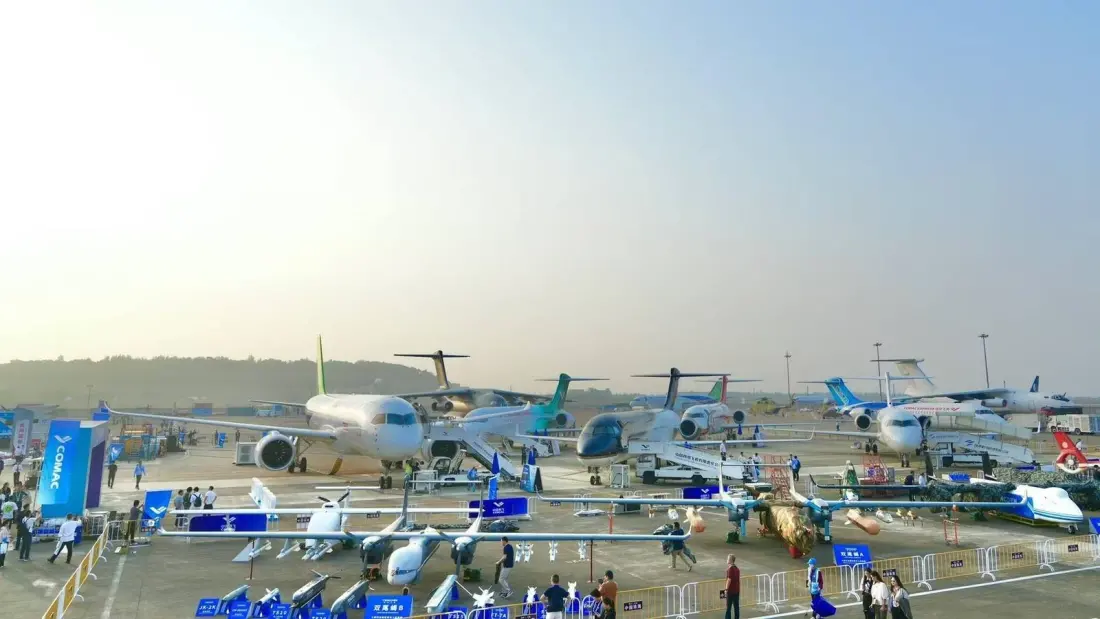
A ten-tonne, all-electric aircraft with room for 19 passengers has completed its first crewed flight in China. The CE-25A, built by COMAC (the state-owned maker behind China's C919 jet), took off on November 14 in Binzhou, Shandong Province, carrying two pilots and a flight-test engineer. It's a milestone that shifts the programme from remote-controlled test flights to real piloted operations — though paying passengers remain a fair way off.
What makes this plane unusual is how it flies. Instead of two turboprop engines, the CE-25A carries ten ducted electric fans across its wings, five per side. This distributed propulsion setup is the current bet in electric aviation: many small motors rather than one or two big ones. The catch, as always, is the battery. COMAC has partnered with CATL — the world's largest battery maker — along with Shanghai Jiao Tong University and other domestic partners, but hasn't revealed battery capacity, energy use, or charging needs. Those numbers will make or break the concept.
The specs so far read like a short-hop machine rather than a regional workhorse. COMAC quotes a maximum range of 400 km (215 nautical miles) and a cruising speed of 300 km/h. Set against established 19-seaters like the Twin Otter, Dornier 228 and Cessna SkyCourier, that's modest — and the published range won't translate into full passenger loads once reserves, weather diversions and operational margins are factored in. Think city-to-city connections where the train or drive is inconvenient, not long commuter networks.
The development path has been methodical. Autonomous testing began on February 2, 2026, and the aircraft has racked up 19 unmanned validation flights before humans were allowed aboard. China's aviation regulator, CAAC, has accepted COMAC's type certificate application under CCAR-25 transport-category rules — a demanding standard for any new design, let alone one with high-voltage systems, battery thermal management and unconventional propulsion to prove safe. No certification date, launch customer or price has been announced.
For travellers, this is a preview of how short-haul flying might change. A quiet, zero-emission 19-seater connecting regional cities could reshape the way people move between secondary cities in China — provided certification succeeds, charging infrastructure appears at both ends of the route, and the economics hold up. None of that is guaranteed. The honest takeaway: the technology is advancing quickly, the dates are not. Anyone booking a seat on an electric commuter flight today is waiting on regulators as much as engineers. Still, with a first crewed flight in the logbook, the CE-25A has moved from concept to aircraft — and that's a step worth watching.
Credit: Simple Flying.