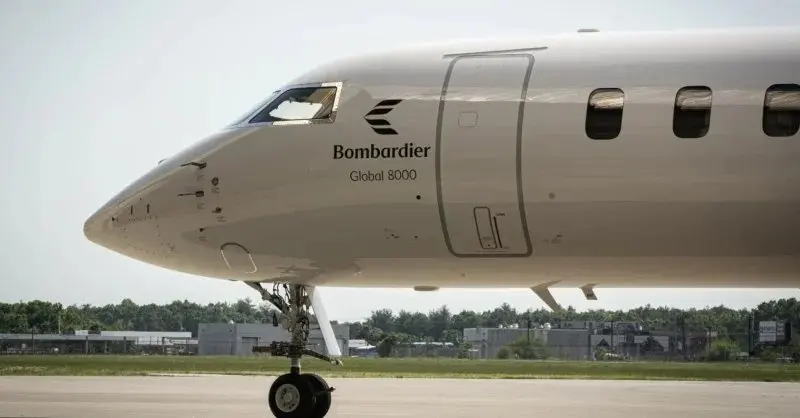
The fastest purpose-built business jet in the world borrows its best idea from birds. Bombardier's Global 8000 is built around the idea that a wing should move with the air rather than fight it — flexing in flight like a bird's wing to absorb turbulence before it reaches the cabin. The result is the Smooth Flĕx Wing, which acts as a kind of in-air shock absorber and promises passengers a noticeably smoother ride.
The engineering story behind that wing is more interesting than a simple nature metaphor. Designers hit a problem known as aileron reversal, a high-speed quirk where the aircraft rolls opposite to the pilot's command. The conventional fix is to stiffen the wing, but that would kill the flexibility that makes the ride comfortable. Instead, Bombardier fitted a first-of-its-kind split aileron — a two-part control surface that works as one for normal roll, then separates at high speeds to prevent the reversal problem.
Speed is only half the pitch. The jet is also claimed to access 30 percent more airports than its closest rival, pairing ultra-long-range capability with the short-runway performance of a lighter aircraft. Practically, that means more direct trips and landings closer to where you actually want to be — fewer connections, less time in a car.
Inside, the four-zone cabin splits into areas for working, dining and entertaining, and sleeping. Longer configurations include a full-size bed and an en suite with shower. The Nuage seats tilt into a zero-gravity posture for rest, large windows flood the space with daylight, and the Soleil lighting system mimics shifting daylight conditions in flight to help reset your body clock before you land. Even the Pur Air system, running a HEPA filter with purified and fresh air, rounds out the comfort brief.
Who is this for? Realistically, ultra-high-net-worth travellers and private aviation buyers weighing an ultra-long-range jet for routes like New York to Hong Kong — roughly 8,000 nautical miles. But the design themes here, from circadian lighting to cabin zoning, are a preview of where premium cabin comfort is heading generally, and a useful benchmark if you're comparing first-class products or chartering long-haul private flights. For most of us, it's a peek at how far manufacturers will go to make 14 hours in the air feel less like flying and more like a hotel that happens to be at 40,000 feet.
Full details on the wing design and cabin come from Elite Traveler.