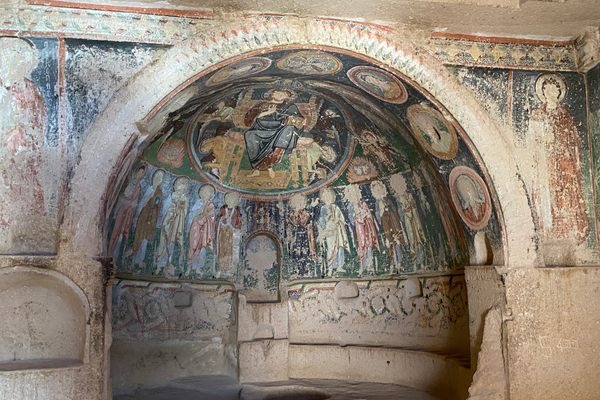
Tucked into the rose-coloured cliffs of Turkey's Red Valley, near the village of Çavuşin in Cappadocia, sits Üç Haclı Kilise — the Church of the Three Crosses. Like so many of the region's wonders, it isn't a built church at all. It was carved straight out of the soft volcanic rock, possibly as early as the AD 600s, and is believed to have sheltered a small monastic community centuries ago.
What makes it worth the effort today are the tenth-century frescoes still clinging to its walls. Among them, Christ appears as ruler of the world, and there's a depiction of his baptism. Look up, too: the ceiling carries large carved Latin crosses that give the church its name. Time and weather have taken their toll — the site is heavily eroded — but that's part of the appeal. This is early Christian art in a raw, unmanicured setting, not behind glass or a ticket barrier.
Getting there is half the adventure. The only access is on foot, hiking through the Red Valley itself, one of Cappadocia's most scenic walking routes with its layered pinks and oranges that shift through the day. The final approach involves climbing a slightly rickety wooden ladder to reach the cave rooms where the frescoes are kept. It's not for everyone — a head for heights and decent footwear help — but the payoff is a view few tourists bother with. Handy bonus: a juice bar sits right next to the church, ready to supply cold refreshment after the climb.
For travellers, this is Cappadocia beyond the balloon crowds. Most visitors cluster around Göreme's famous open-air museum and the fairy chimneys of Pasabağ. The Red Valley trail offers the same Byzantine heritage with a fraction of the foot traffic, plus genuinely good hiking between villages like Çavuşin and Göreme. Pair the church with a morning walk — the light on the red rock is best early, and the valley is cooler before midday.
It's a fit for independent walkers, history buffs and photographers who'd rather earn their sights than step off a coach. If you can handle a ladder and a few kilometres of trail, one of Anatolia's oldest surviving church interiors is yours, with fresh pomegranate juice at the end of it. Full write-up courtesy of Atlas Obscura.