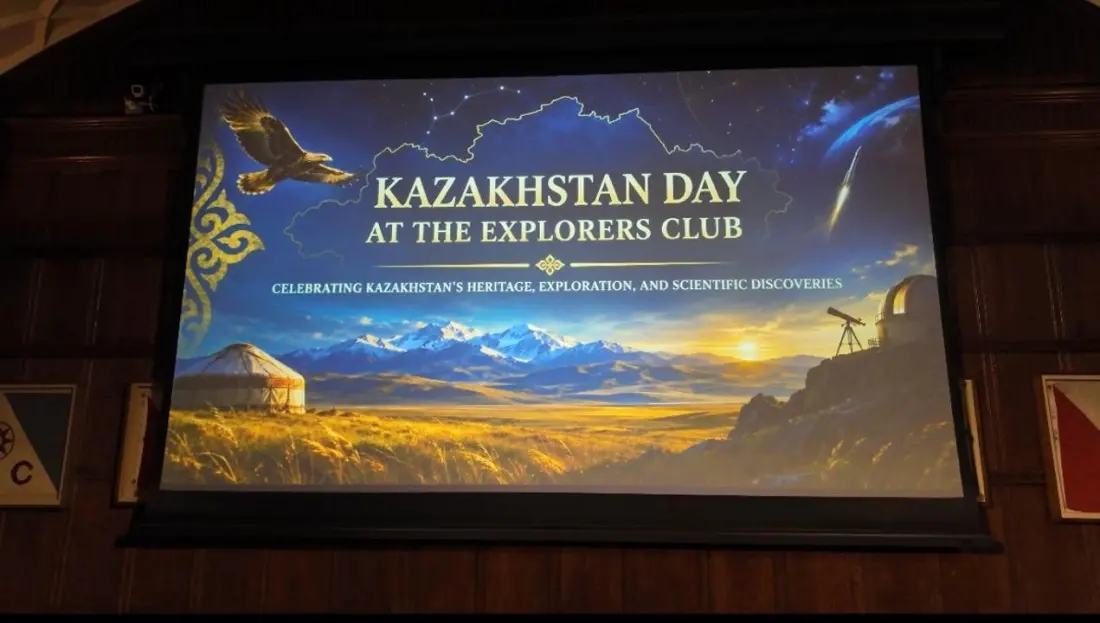
The Explorers Club — the century-old New York institution behind Everest summits, deep-ocean dives and lunar expeditions — now has a Central Asia chapter, launched on November 12 with Kazakhstan as its base. The inauguration took place at the club's New York headquarters, drawing scientists, diplomats and conservation experts, including Kazakhstan's Ambassador to the US Magzhan Ilyassov and club president emeritus Richard Wiese.
With more than 30 chapters worldwide, the club functions as a networking and funding machine for field science. Chapters run lectures, seminars and expeditions and hand out field-research grants to students. The new Central Asia chapter aims to plug the region's researchers into that network, with an eye on archaeology, conservation and opportunities for young scientists to join international expeditions.
The star of the launch was arguably a antelope. Kazakh conservationist Albert Salemgareyev presented the Altyn Dala Conservation Initiative, the project credited with bringing the saiga antelope back from the brink. His message wasn't a victory lap — it was a recruitment pitch. Saiga numbers are climbing, but new roads and railways are cutting across the steppe, and keeping migration routes open is the next battle. He wants international researchers on Altyn Dala's field teams, plus the long-term funding the club's network can unlock.
The wishlist is concrete: joint expeditions to study steppe ecosystems, AI tools to spot and count saigas in aerial survey photos, and GPS tracking to map how herds move — especially across the Ustyurt Plateau and toward the Kazakhstan-Uzbekistan border, where migration corridors hit obstacles. Tracking herds alongside farmers' records could also ease saiga-livestock conflicts over pasture. In Torgai in the north, the reintroduced kulan and Przewalski's horses offer a live experiment in how grazing shapes steppe vegetation and birdlife.
History got airtime too. British explorer Nick Fielding traced the ancient cities along the Syr Darya River, the Silk Road-era towns that linked Central Asia's civilizations — a reminder that the region's exploration potential spans both wildlife and ruins.
Why should a traveller care? Because Kazakhstan's vast steppe is quietly becoming one of the world's most compelling conservation destinations, and this chapter signals growing international scientific traffic there. If you've ever fancied seeing saiga herds, Przewalski's horses or the empty grandeur of Ustyurt — or Silk Road sites along the Syr Darya — expect better-run research expeditions, citizen-science openings and more coverage of a landscape most travellers still skip.