
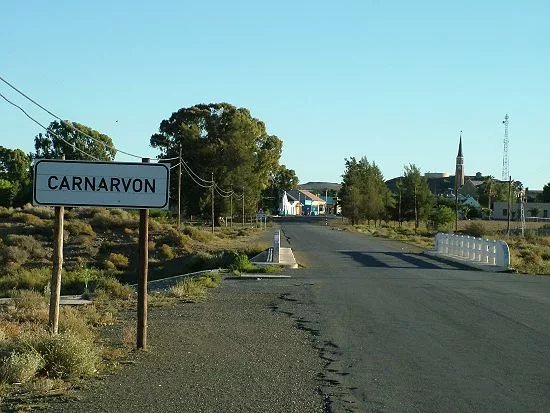
Most travellers would struggle to find Carnarvon on a map. The little Northern Cape town sits on dry Karoo plains ringed by flat-topped koppies, a day's drive from anywhere, and for most of its 150-year history its business was sheep. Then the telescopes arrived.
Today Carnarvon is the gateway to MeerKAT, a 64-dish radio telescope array about 90km from town and one of South Africa's most significant scientific projects. It's a precursor to the Square Kilometre Array: SKA-Mid is planned to eventually comprise 197 dishes, including MeerKAT's existing ones, probing pulsars, gravitational waves and possibly even signs of life beyond our galaxy. Why here? The Karoo's remoteness and very low radio interference make it close to ideal for radio astronomy — the same emptiness that made sheep farming marginal makes the skies exceptional.
But the town's story started long before the science. A Rhenish mission station was established at Schietfontein in the 1840s; the settlement became Harmsfontein and was renamed Carnarvon in 1874 after the British Colonial Secretary Lord Carnarvon. You can still read that past in the buildings. The Carnarvon Museum occupies a 1907 Dutch Reformed Church community hall, and outside stands one of the region's distinctive corbelled houses — domed structures built entirely from layered flat stone, a clever response to a landscape short on timber. Wander further and you'll find Victorian-era homes and the nearby Skietfontein trail, which traces the area's earlier settlement history.
The astronomy boom has quietly reshaped local life. MeerKAT and the SKA have brought training, jobs, bursaries and work for local technicians and businesses. On the tourism side, Carnarvon has built astro-tourism experiences that pair night-sky viewing with local storytelling — treating the Karoo's darkness as something with cultural and scientific value, not just an absence of light. The significance wasn't lost on government: South Africa's National Astro-Tourism Strategy was launched in Carnarvon in 2024, positioning the town and the surrounding Karoo corridor as a place where science, tourism and rural development can feed each other.
That's the real appeal here. Carnarvon isn't a big-draw destination with a checklist of sights, but it's a genuinely layered one — mission-station history, stone architecture, working farms, wide horizons and now a seat at one of the world's most ambitious astronomy projects. Spend a night looking up, sure, but spend a morning walking the streets first. The stars are the newest chapter, not the whole book.
If your South African trip already includes the Karoo — perhaps the Valley of Desolation near Graaff-Reinet — Carnarvon fits naturally into a slow road-trip loop through the region, ideally timed around a new moon.