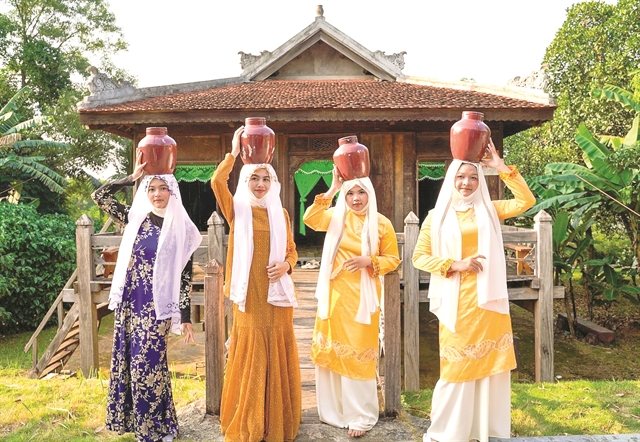
In Châu Phong Commune, in Vietnam's southern An Giang Province, the clack of handlooms is part of daily life. The village, home to the Chăm Muslim community, has been officially recognised by provincial authorities as a long-established traditional craft — and it's one of the few places in the Mekong Delta where weaving remains a living, working tradition rather than a museum piece.
Women are at the heart of it. They weave the fabrics that clothe the community and trade beyond it, producing textiles that carry centuries of cultural identity in their patterns. The craft once began at the very source: villagers grew their own mulberry trees, raised silkworms and dyed thread with natural materials. Those plant-based dyes were remarkably tough, holding their colour through sun and repeated washing while giving the cloth a subtle sheen that still defines Chăm textiles today.
Silk production has faded from the village, so most everyday weaving now uses synthetic thread. Genuine silk is saved for what matters most — wedding and ceremonial garments. That hierarchy tells you a lot about how the community dresses: daily wear is practical, but festival and religious dress is where the craftsmanship shows off.
Men keep it simple day to day, adding a sarong and a kapeak — a brimless cap — for occasions and for leaving the house, plus dedicated formal attire for religious rituals. Women's traditional dress is more elaborate: the mispok, a sheer embroidered headscarf edged with metallic thread that can take weeks of skilled handwork to make; the aw kamei, a long dress falling below the knee; plus sarongs and wide-leg trousers. Festival outfits come in vivid colours, finished with red tassels, iridescent beads at the neckline and boldly patterned waist sashes.
For travellers, this is a genuinely hands-on cultural stop. An Giang sits in the far south of the Mekong Delta, near the Cambodian border, and Châu Phong is reachable from nearby Châu Đốc, a pilgrimage town on the Bassac River. You can see looms at work, buy directly from weavers and — if you time it with a wedding or festival — see the full regalia in action, beads and all. It's a rare chance to watch a craft that started as families making their own clothes evolve into trade with neighbouring communities, all in a single morning's wander.