Two European food traditions are looking for a bigger audience in Vietnam. The Italian Consortium for the Protection of Asiago Cheese and France's Federation of Charcuterie and Delicatessen Companies (FICT) held a press briefing in Hanoi to promote their products to Vietnamese importers, retailers and consumers, leaning on the EU-Vietnam Free Trade Agreement (EVFTA) to smooth the path.
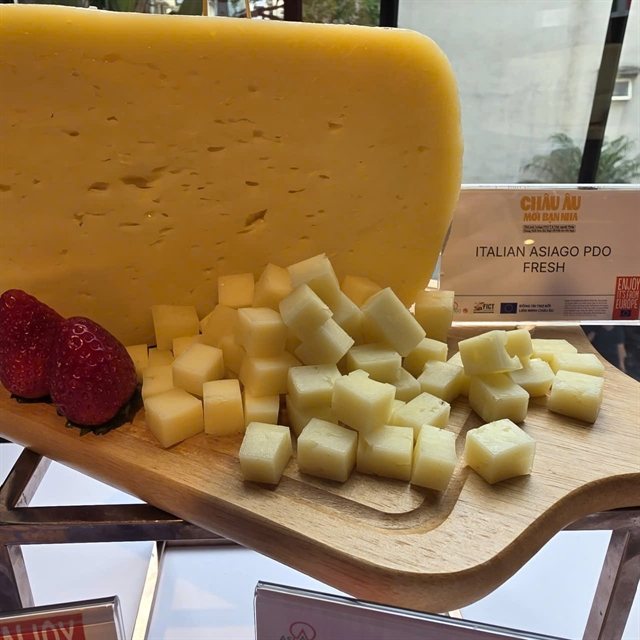
Asiago PDO is a protected cow's milk cheese produced within a legally defined zone across Veneto and Trentino-Alto Adige in northeastern Italy. The consortium behind it counts 37 producers and six maturing facilities, and every wheel carries set weights, dimensions and identification marks tied to its maturity — a traceability system meant to guarantee quality. Two styles exist: Fresh Asiago PDO, made from whole milk and aged just 20 to 40 days, with a soft texture and milky creaminess; and Aged Asiago PDO, made from partially skimmed milk and matured from three to 15 months or more, developing a firm texture and savoury, hay-scented flavour. A useful detail for the lactose-intolerant: after six months of maturation the cheese becomes naturally lactose-free.
The French side of the pitch is equally deep-rooted. FICT, founded in 1924, represents more than 310 businesses and a catalogue of over 450 charcuterie specialties — pâtés, terrines, galantines, jambon, dry-cured hams and sausages made through salting, drying, smoking, cooking and curing. The craft dates back to 15th-century guilds of charcutiers, who used every part of the animal to avoid waste, and regional variation remains central: some products carry European recognition for their origin or traditional methods.
The commercial context matters here. The EVFTA gives European producers a more favourable framework for selling into Vietnam, where demand for food with clear provenance is rising. Both associations say they want to fill out the premium segment of the market, and Vietnamese businesses stand to broaden their ranges and brand appeal in turn. Earlier this year the Food and Hospitality Vietnam expo in Ho Chi Minh City helped connect European producers with local partners, part of the three-year "Europe, Be My Guest" campaign promoting European food culture in the country.
That said, market access on paper is not the same as cheese on the shelf. Expansion still hinges on consumer appetite, distribution networks and meeting Vietnam's food import rules — hurdles both delegations acknowledged.
For travellers, the takeaway is a food scene in flux. Vietnam's dining culture, long defined by street food and rice-based cuisine, is steadily absorbing European gourmet products, particularly in Hanoi, Ho Chi Minh City and Da Nang. Expect more Italian and French specialty items on hotel brunch spreads, in boutique grocers and on fusion restaurant menus — and, for those heading to Italy or France themselves, a chance to try Asiago and regional charcuterie at the source.