Most people picture the Mississippi with jazz bars and paddle steamers in New Orleans. A recent trip took the opposite approach: starting near the river's source and working through the Upper Midwest, where the water is young, the bluffs are steep and the river still does actual work. The full river runs 3,766 kilometres through 10 states, from Lake Itasca in northern Minnesota to the Gulf of Mexico — far too much for one week, so this route covered Minnesota, Illinois and Wisconsin.
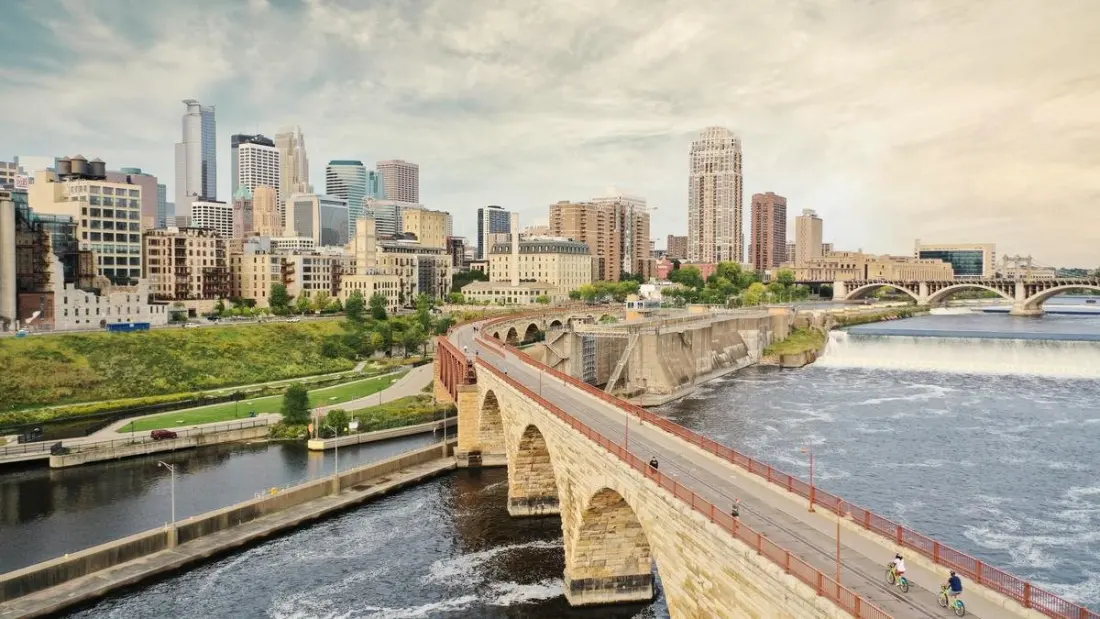
The journey begins at Bdóte, the confluence of the Minnesota and Mississippi Rivers near Minneapolis. It's a sacred creation site for the Dakota people, and a calm, deliberate place to meet a river before it gathers muscle. Back in the city, a river walk runs from the Guthrie Theatre in the Mill District past the Stone Arch Bridge — a former railroad crossing — and over Saint Anthony Falls.
From Minneapolis, the Great River Road (voted the US's best scenic drive in 2025 and 2026) winds south through bluff country, stopping at Red Wing, Wabasha and Winona. Wabasha's National Eagle Center is worth the detour: four resident eagles named Angel, Was'aka, Latsch and Perseus, plus galleries holding Preston Cook's collection of more than 40,000 eagle artefacts, including original John James Audubon works and even a Wonder Woman nod thanks to the eagle on her breastplate.
Galena, Illinois sits in the Driftless Zone — terrain the glaciers never flattened — so hills and bluffs replace the flat farm grid. Next comes Moline in the Quad Cities, where the Mississippi shows its working side; a water taxi ride after a spin around the John Deere Pavilion puts you right on the water. A prairie detour to Springfield brings the Abraham Lincoln Presidential Library and Museum, home to the handwritten Gettysburg Address, the Emancipation Proclamation and Mary Todd Lincoln's wedding dress.
Madison, Wisconsin shifts the mood entirely: a lake-country university town on the isthmus between Lakes Mendota and Monona, famous for campus buzz and its sunburst chairs. The State Capitol hides fossils — nautiloids and ammonoids — in its walls. Milwaukee pairs two wildly different museums: the Milwaukee Art Museum with its sail-like structure and collections running from Picasso and Rodin to an Egyptian sarcophagus, and the Harley-Davidson Museum, a shrine to the American road trip itself. The finale is Chicago, where Lake Michigan stretches so far from the Tilt Deck it reads as an inland sea, with the obligatory Bean stop at Millennium Park.
Plot the route on a map and it traces an inverted question mark — fitting, says the writer, for a trip that set out to find the storied Mississippi and instead found a young working river and lakes that behave like oceans. For travellers, this is a strong alternative to the Deep South stretch: scenic drives, eagle sanctuaries, Lincoln history and Great Lakes cities all within a week's drive. The southern half — Twain country, the Blues, the delta — is clearly waiting as part two.